
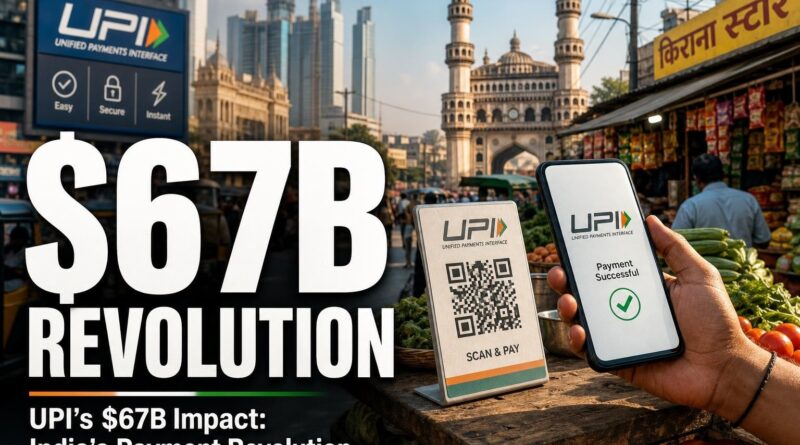
UPI’s $67B Impact: India’s Payment Revolution
UPI’s $67B Impact: India’s Payment Revolution
Before April 11, 2016, more than 90 percent of transactions in India happened in cash. Every trip to the market, every bill payment, every small purchase — physical notes changing hands. Then one system quietly launched, and within a decade it had saved the Indian economy approximately $67 billion. That’s roughly INR 5.5 trillion. Not earned. Saved. And right now, a debate about merchant fees is putting the entire model under pressure.
What UPI Actually Is — And Why It Was Built
Cash isn’t just inconvenient. It’s expensive. Printing it, transporting it, storing it, counting it — all of that costs money at every level of the economy. India knew this, and the National Payments Corporation of India (NPCI) set out to build something better.
The result was the Unified Payments Interface — a system that runs on top of an existing framework called the Immediate Payment Service (IMPS) and sits under the oversight of the Reserve Bank of India. In plain terms: UPI is the layer that lets two bank accounts talk to each other instantly, through a mobile phone, using nothing more than a unique UPI ID. No account numbers. No branch codes. No waiting.
It launched on April 11, 2016. The timing mattered. Smartphone ownership was climbing fast across India, and internet costs were collapsing. UPI didn’t just offer a new way to pay — it arrived exactly when hundreds of millions of people were ready to use it.
What made it different from earlier digital payment tools was its open design. Built as an open-source API, UPI allowed banks, apps, and businesses to plug into the same system. That meant competition between apps — which drove better features — while the underlying rail stayed unified and free.
The 2020 Decision That Changed Everything
By 2020, UPI had millions of users. But small merchants — the vegetable vendor, the auto-rickshaw driver, the neighbourhood kirana store — were still hesitant. The reason was simple: cost.
Every digital payment system traditionally charges a Merchant Discount Rate, or MDR. Think of it as a small processing fee that the merchant pays each time a customer swipes a card or taps a phone. For large retailers, this is manageable. For a street vendor earning thin margins on every sale, even a fraction of a percent adds up fast.
The Indian government made a call that year: MDR on UPI transactions would be waived entirely. Zero. The cost barrier that had kept small businesses at the edge of the digital economy was removed overnight.
The effect was real. Merchants who had never accepted digital payments suddenly had no financial reason to refuse them. The unified payments network expanded not just upward into cities and corporations, but downward into the everyday economy — the chai stall, the parking attendant, the temple donation box.
That single policy decision is a large part of why UPI’s savings figure reached $67 billion. When friction disappears, adoption accelerates.
The Crack in the Model
Here’s where the story gets complicated — and why this topic is back in the news right now.
Zero MDR sounds like a win for everyone. Merchants pay nothing. Consumers pay nothing. But someone has to fund the infrastructure. The banks processing these transactions, the technology companies maintaining the apps, the NPCI running the rails — none of that is free to operate.
For years, the cost was effectively absorbed or subsidised. That arrangement is now being re-examined. Reports in 2026 indicate that India is taking steps to reintroduce merchant fees on UPI transactions. The current thinking is careful: UPI is unlikely to become a paid service for consumers. But a limited set of merchants — likely larger businesses with higher transaction volumes and values — could eventually be charged.
The phrase being used in financial discussions is telling: “MDR benefits will depend on merchant mix and transaction value.” Translation — not all merchants will be treated the same. A large retail chain processing thousands of transactions a day is a different case from a street vendor doing ten.
This distinction matters enormously. If the fee structure is designed well, the small merchant stays protected and the unified payments ecosystem keeps growing at the base. If it’s designed poorly, the very businesses that drove mass adoption could face pressure to return to cash.
Final Thought
The $67 billion figure is not just an economic statistic — it is the direct result of a specific sequence of decisions: build an open system in 2016, remove merchant fees in 2020, and let adoption compound. The upcoming MDR conversation is, in a real sense, a test of whether India can sustain that model without dismantling what made it work. If the new fee structure protects small merchants while creating a sustainable revenue base from high-volume players, UPI could keep growing. If it doesn’t, the 90-percent-cash economy that existed before April 11, 2016 has a long memory — and old habits are easier to return to than most people think.
Frequently Asked Questions
What is UPI and how does it work?
UPI, or Unified Payments Interface, is a system built by NPCI that lets two bank accounts transfer money instantly via a mobile phone using a unique UPI ID, with no account numbers or branch codes required.
How much money did UPI save India?
UPI saved the Indian economy approximately $67 billion, or roughly INR 5.5 trillion, by reducing reliance on cash, which is expensive to print, transport, store, and count at every level of the economy.
When did UPI launch in India?
UPI launched on April 11, 2016, at a time when smartphone ownership was rising rapidly and internet costs were falling, making hundreds of millions of Indians ready to adopt digital payments.
Recommended Reading
Explore these hand-picked resources to dive deeper into this topic:
- The Lean Startup by Eric Ries
- India’s Fintech Revolution by Nandan Nilekani
- Kindle Paperwhite (e-reader device)
As an Amazon Associate, we earn from qualifying purchases. This helps support Fact Storm Hub at no extra cost to you.
Sources
- https://en.wikipedia.org/wiki/Unified_Payments_Interface
- https://business.cornell.edu/news/2024/12/20/indias-unified-payments-interface-has-revolutionized-its-digital-payments-market/
- https://stripe.com/resources/more/unified-payments-interface-upi
- https://www.systemicrisk.ac.uk/sites/default/files/2025-02/DP-131.pdf
- https://www.weforum.org/stories/2023/06/india-unified-payment-interface-impact/

🤖 AI Content Disclosure
This article was created using AI-assisted research and writing tools, then reviewed for quality and accuracy. Facts are sourced from publicly available web research, but readers should verify critical information from primary sources.
Published for educational and entertainment purposes. Last reviewed: August 2026