
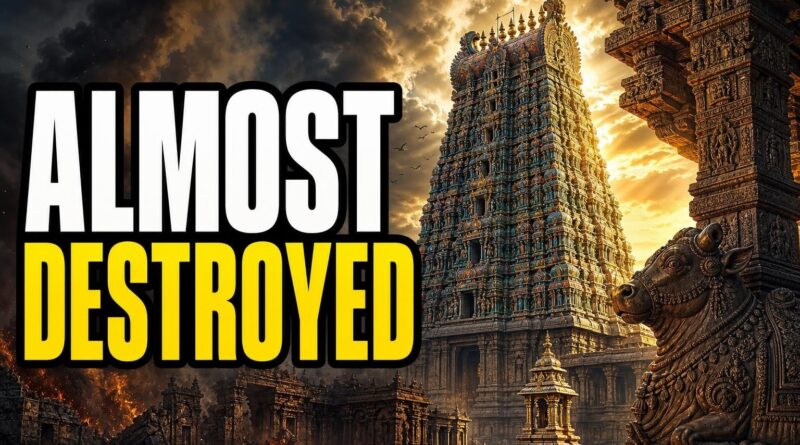
Meenakshi Temple: The Miracle That Almost Never Was
Meenakshi Temple: The Miracle That Almost Never Was
There’s a city in Tamil Nadu where the temple is the city. Not a landmark inside it. Not a tourist attraction beside it. The temple is the reason Madurai exists, the reason people have been walking its streets for centuries, and the reason that whenever something happens to it — a renovation, a consecration, a restoration — the entire city stops what it’s doing and shows up.
That’s the story of the Meenakshi Amman Temple. And once you understand what this place actually is, you’ll never look at it the same way again.
A Temple With Two Gods — And One Identity
Most temples are built for one deity. The Meenakshi Sundareswarar Temple, as it is formally known, is built for two — and that’s not a small distinction.
The principal deities are Meenakshi, also known as Angayarkanni, and Sundareswarar, also known as Chokkar, another name for Shiva. They are worshipped here as a divine couple. The temple is, in the truest sense, a twin temple — two separate sanctuaries housed within one enormous complex, each with its own rituals, its own inner shrine, its own axis of devotion.
This dual structure shapes everything about how the temple functions. Priests conduct separate rituals for each deity. Festivals are designed around both. Even the architecture reflects a kind of sacred symmetry — two divine presences, two sets of towers, one shared space.
In most religious traditions, a temple is a place you visit. Here, it is a relationship you participate in. That distinction has kept this temple alive across centuries when many others fell silent.
The Geography That Makes This Place Unusual
Sit with this for a moment: the Meenakshi Amman Temple stands on the southern bank of the Vaigai River in Madurai, Tamil Nadu, at an elevation of 144 meters.
That number — 144 meters — is easy to scroll past. Don’t.
For a temple complex of this scale, in a city built on a river plain, that elevation matters. It means the site was chosen with deliberate care. Ancient builders didn’t pick locations at random. Proximity to a river meant water for rituals, for the surrounding community, for agriculture. Elevation meant the structure would endure — above flood lines, visible from a distance, dominant on the landscape.
The coordinates place it precisely: 9°55′11″N, 78°07′10″E. On a map, that’s the heart of Madurai. In practice, it means the temple isn’t just in the city — it is the geographic anchor around which the city was organized. Streets in old Madurai radiate outward from this complex. The city grew from the temple, not the other way around.
That’s not a metaphor. That’s urban history.
What a Kumbhabhishekam Actually Means
The reason this temple surged back into conversation recently connects to its Kumbhabhishekam — the sacred reconsecration ceremony that temples undergo after major restoration work.
A Kumbhabhishekam is not a routine religious event. It is, in Hindu temple tradition, the moment a restored temple is spiritually reactivated. The word itself refers to the consecrated pot — the kumbha — that is filled with sacred water and raised to the top of the temple tower during the ceremony. When that water flows over the tower, the temple is considered renewed, alive again, its divine energy restored.
For a temple as ancient and as layered as the Meenakshi Amman Temple, a Kumbhabhishekam is an event the city treats as once-in-a-generation. It draws hundreds of thousands of devotees. It shuts down streets. It turns Madurai, for those days, into something that resembles a city from another era — dense with ritual, sound, and collective memory.
The fact that Madurai still does this — that it still can do this — is itself the story.
Why This Temple Has Survived When Others Haven’t
Ancient temples across South Asia have been lost to time, to invasion, to neglect, to the slow erosion of communities that once sustained them. The Meenakshi Amman Temple has not. And the reason is less mystical than you might expect.
It survived because it was never just a religious site. It was an economic center, a cultural institution, a civic identity. Merchants built around it. Festivals drew trade. The temple’s administration managed land, water, and resources for the surrounding region.
When the structure needed repair, there were people with both the will and the means to repair it. When the rituals needed continuity, there were communities whose entire identity was bound to maintaining them. The temple didn’t survive despite being embedded in daily life. It survived because of it.
That model — a sacred space that is also a living institution — is rarer than it sounds. And it’s why, when Madurai holds a Kumbhabhishekam, it isn’t performing nostalgia. It’s maintaining something that has never actually stopped.
Final Thought
The Meenakshi Amman Temple isn’t remarkable because it’s old. Plenty of old things crumble. It’s remarkable because a city on the southern bank of the Vaigai River decided, generation after generation, that this twin temple — built for Meenakshi and Sundareswarar — was worth the effort of keeping alive. Every Kumbhabhishekam is that decision made visible. And every time Madurai shows up for it, the answer is the same: yes, still worth it.
Frequently Asked Questions
Who are the main deities worshipped at Meenakshi Amman Temple?
The temple is dedicated to two deities — Meenakshi (also known as Angayarkanni) and Sundareswarar (also known as Chokkar, a name for Shiva). They are worshipped as a divine couple, each with their own inner shrine and separate rituals.
What is the formal name of the Meenakshi Amman Temple?
The temple’s formal name is the Meenakshi Sundareswarar Temple, reflecting its twin dedication to both Meenakshi and Sundareswarar. It functions as two separate sanctuaries housed within one enormous complex.
Where is the Meenakshi Amman Temple located?
The Meenakshi Amman Temple is located in Madurai, Tamil Nadu, on the southern bank of the Vaigai River at an elevation of 144 meters. The temple is considered the very reason the city of Madurai exists.
Recommended Reading
Explore these hand-picked resources to dive deeper into this topic:
- The Temples of South India by George Michell
- Sacred Architecture of India by Aniruddha Dasgupta
- Meenakshi Temple Documentary (4K historical series)
As an Amazon Associate, we earn from qualifying purchases. This helps support Fact Storm Hub at no extra cost to you.
Sources
- https://en.wikipedia.org/wiki/Meenakshi_Temple
- https://www.shutterstock.com/image-photo/madurai-meenakshi-amman-temple-south-india-1773536165
- https://www.alamy.com/stock-photo/meenakshi-temple-india.html?pseudoid=970E0CF1-149E-4872-8C13-B6E0153078F5
- https://www.youtube.com/watch?v=gDm8RuAwusc
🤖 AI Content Disclosure
This article was created using AI-assisted research and writing tools, then reviewed for quality and accuracy. Facts are sourced from publicly available web research, but readers should verify critical information from primary sources.
Published for educational and entertainment purposes. Last reviewed: September 2026