
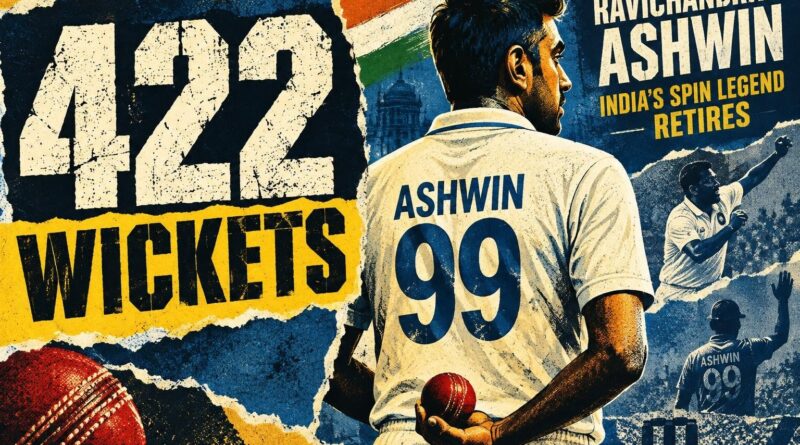
Ravichandran Ashwin: India’s Spin Legend Retires
Ravichandran Ashwin: India’s Spin Legend Retires
The debate about Kuldeep Yadav’s place in India’s squad is loud right now. Former legends are calling the decision to drop him “beyond understanding.” And somewhere in that debate is a name that keeps coming up as the standard — the benchmark for what a world-class Indian spinner looks like.
Ravichandran Ashwin.
But here’s what that debate misses entirely: the man who set that benchmark didn’t stop when Test cricket slowed down for him. He packed his bags and flew to San Francisco.
The Boy From Chennai Who Rewired Indian Bowling
Born on 17 September 1986 in Chennai, Tamil Nadu, Ravichandran Ashwin didn’t look like a future great when he started. He was a right-arm off-spin bowler — a style of bowling that was considered almost old-fashioned by modern cricket standards. Fast bowlers got the glamour. T20 cricket wanted pace and mystery spin. Off-spin? That was the thing your grandfather watched.
Ashwin made it dangerous anyway.
What separated him from other off-spinners wasn’t just the turn he extracted from a pitch. It was the thinking. Every batsman who faced Ashwin described the same experience — the feeling that he was being studied, catalogued, and then trapped. Ashwin didn’t bowl at batsmen. He bowled at their habits.
Over 106 Test matches, that approach produced numbers that belong in a different era of Indian cricket — a wicket tally that would place him among the greatest Test bowlers his country had ever produced. And alongside those wickets, something most people forget entirely.
The Stat Nobody Brings Up in the Spin Debate
3,503 Test runs. Six centuries. A highest score of 124.
Those are Ravichandran Ashwin’s batting numbers — accumulated while batting in the lower order across 106 Test matches, averaging 25.76. For a specialist bowler walking in at number seven or eight, that isn’t a footnote. That’s a second career hidden inside the first one.
Think about what that means in practice. India is in trouble, middle order gone, pressure suffocating. Ashwin walks in and doesn’t just hang around — he scores hundreds. Six of them. That’s not a tail-ender contributing. That’s a genuine match-saving weapon arriving when the match looks lost.
The Kuldeep debate focuses on wickets, as it should. But when selectors weigh up what a spinner brings to a Test side, Ashwin redefined the question entirely. He wasn’t a bowling option with some batting ability. He was two match-winners in one jersey — and the batting half of that equation almost never gets the credit it deserves.
The Retirement Nobody Saw Coming
Test careers at the highest level have a rhythm. You peak, you decline slowly, and then one day the selectors stop calling. Most cricketers drift out. Ashwin didn’t drift.
He retired from international cricket on his own terms — a decision that caught many off guard precisely because it felt early, deliberate, and forward-looking rather than forced. There was no farewell tour, no slow fade. One day he was playing Test cricket; the next, he was choosing what came after it.
And what came after it was not the commentary box. It was not franchise cameos in familiar leagues. It was San Francisco.
Ashwin signed with San Francisco Unicorns for Major League Cricket 2026 — becoming the first India international to appear in U.S.-based Major League Cricket. That distinction matters. He wasn’t following a path other Indian greats had worn smooth. He was cutting a new one through territory where cricket barely has a foothold, in a country where the sport is still fighting for shelf space alongside the NFL and the NBA.
That’s not a retirement. That’s a reinvention.
America, a Knee Injury, and What Two New Leagues Are Actually Telling Us
The MLC 2026 stint was cut short — Ashwin was ruled out of the remainder of the tournament with a knee injury. Frustrating, yes. But the injury is almost beside the point.
What matters is what his presence in both MLC and ETPL signals about cricket’s trajectory. Ashwin wasn’t just playing in America for the experience. He was arriving as a credibility transfer — a 106-Test veteran whose name alone tells American sports investors and casual fans that this league is serious enough to attract the real thing.
The same logic applies to his appointment as captain and mentor of Dublin Guardians in the inaugural ETPL season. Two new leagues. Two countries — the United States and Ireland — where cricket is actively trying to embed itself into mainstream sports culture. And in both cases, Ashwin is not a passenger. He is captain, mentor, and marquee name simultaneously.
Cricket’s global expansion doesn’t happen through broadcast deals alone. It happens when the sport’s most recognisable figures choose to show up in places where showing up is genuinely difficult. Ashwin is doing exactly that — and the fact that he’s doing it with a knee injury in the rearview mirror rather than a quiet retirement in the foreground says everything about what drives him.
Final Thought
The argument about Kuldeep Yadav’s omission is legitimate, and the former legends raising it deserve to be heard. But the Ashwin standard they’re invoking is more complicated than wickets alone. His 3,503 Test runs — including 6 centuries and a highest score of 124 — remind us that the greatest Indian spinners aren’t just bowling assets. They’re cricketers in the fullest sense.
And the fact that Ashwin, at this stage of his career, is captaining the Dublin Guardians and signing for San Francisco Unicorns rather than retiring quietly tells you something the wicket column never could: the same instinct that made him study batsmen’s habits for two decades is now studying something bigger — where cricket goes next, and whether he can help take it there.
Frequently Asked Questions
How many Test wickets did Ravichandran Ashwin take in his career?
Ravichandran Ashwin played 106 Test matches and accumulated a wicket tally that places him among the greatest Test bowlers India has ever produced, establishing him as the benchmark for world-class Indian spin bowling.
What are Ravichandran Ashwin’s batting stats in Test cricket?
Ashwin scored 3,503 Test runs while batting in the lower order, including six centuries and a highest score of 124, averaging 25.76 across 106 Test matches — remarkable numbers for a specialist bowler.
Where was Ravichandran Ashwin born and what type of bowler is he?
Ashwin was born on 17 September 1986 in Chennai, Tamil Nadu. He is a right-arm off-spin bowler known for studying batsmen’s habits and trapping them strategically, making a traditionally old-fashioned style dangerous again.
Recommended Reading
Explore these hand-picked resources to dive deeper into this topic:
- Eleven Gods: The Untold Story of Sikandar Bakht by Boria Majumdar
- The Autobiography of Ravichandran Ashwin by Ravichandran Ashwin
- ESPN+ Cricket Documentary Subscription
As an Amazon Associate, we earn from qualifying purchases. This helps support Fact Storm Hub at no extra cost to you.
Sources
- https://en.wikipedia.org/wiki/Ravichandran_Ashwin
- https://www.cricinfo.com/cricketers/ravichandran-ashwin-26421
- https://www.cricbuzz.com/profiles/1593/ravichandran-ashwin
- https://www.youtube.com/@AshwinRavi99
- https://www.raviashwin.com/
🤖 AI Content Disclosure
This article was created using AI-assisted research and writing tools, then reviewed for quality and accuracy. Facts are sourced from publicly available web research, but readers should verify critical information from primary sources.
Published for educational and entertainment purposes. Last reviewed: October 2026