
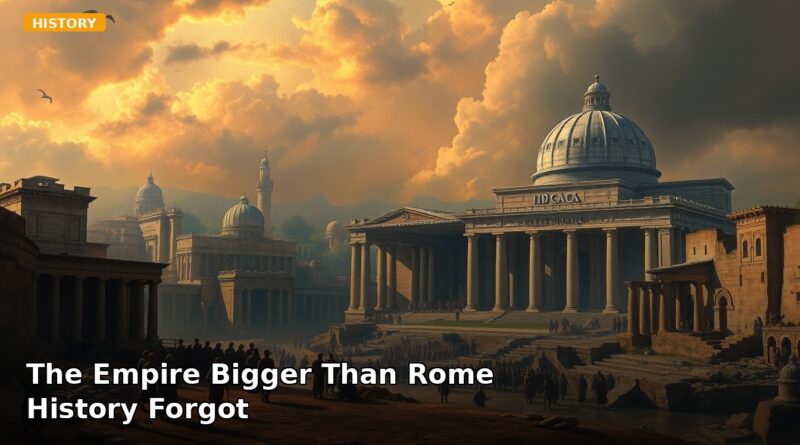
The Empire Bigger Than Rome History Forgot
The Empire Bigger Than Rome History Forgot
There’s a civilization that controlled more territory than the Roman Empire at its peak, built the largest religious monument on Earth, and then — almost completely — vanished from Western memory. You’ve probably heard of Rome. You’ve probably heard of the Mongols. But the Khmer Empire? Most people couldn’t place it on a map, let alone explain what it actually was.
That’s the real story here. Not just what the Khmer Empire built — but why a civilization this powerful, this architecturally sophisticated, this geographically dominant, somehow got written out of the version of ancient history most of us were taught.
The Kingdom Nobody Taught You About
Here’s the setup: for roughly 600 years — from around the 9th century to the 15th century CE — the Khmer Empire was the dominant political force in mainland Southeast Asia. At its territorial height, it stretched across what is now Cambodia, Thailand, Laos, and southern Vietnam. That’s an area larger than modern France and Germany combined.
But here’s what makes this genuinely strange. This wasn’t a loose confederation of tribes or a nomadic raiding culture. The Khmer Empire had a centralized administration, a sophisticated hydraulic engineering system, a written legal code, and a capital city — Angkor — that, at its peak around the 12th century, was home to an estimated 750,000 to one million people.
Let that number land. One million people in a single city, in the 12th century. London at the same time had roughly 15,000. Paris had perhaps 25,000. Angkor wasn’t just large for its era — it was, by a significant margin, the largest urban settlement on the planet. And yet somehow, when we talk about great ancient civilizations in school, this one rarely makes the list.
The geography alone should have made it famous. The Khmer Empire sat at the crossroads of ancient trade routes connecting India, China, and the maritime world of the Indonesian archipelago. It wasn’t isolated. It was, in every meaningful sense, a hub of the ancient world.
What They Actually Built — and Why It Still Defies Explanation
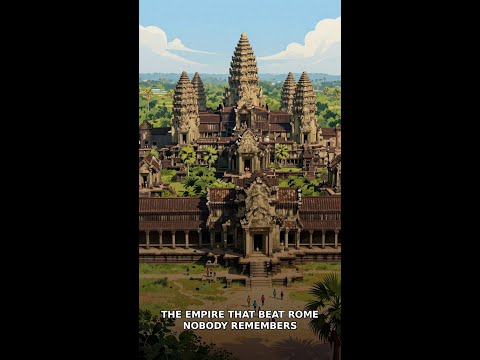
Most people know Angkor Wat as “that temple in Cambodia.” Fewer people know what it actually represents as an engineering achievement.
Angkor Wat is the largest religious monument ever constructed by human hands. Not the largest ancient monument — the largest religious monument, full stop, including everything built since. Its outer wall encloses an area of roughly 1.6 square kilometers. The moat surrounding it stretches nearly 5.5 kilometers in length. The entire structure was built without the use of mortar — the sandstone blocks, some weighing several tons, were fitted together using a dry-stacking technique so precise that many joints are still airtight after 900 years.
But Angkor Wat is only one structure in a complex that covers over 400 square kilometers. The greater Angkor region contains hundreds of temples, reservoirs, canals, and roads. The hydraulic network — the system of reservoirs called barays and the channels connecting them — was an engineering project of a scale that modern archaeologists are still mapping using LiDAR (Light Detection and Ranging) technology. Aerial LiDAR surveys conducted in recent years have revealed entire city grids, road networks, and water management systems hidden beneath the jungle canopy that were completely unknown to researchers as recently as two decades ago.
Here’s the part that stops researchers cold: the Khmer hydraulic system wasn’t just impressive — it was the entire reason the empire existed. The barays could store enough water to irrigate rice paddies across a region that would otherwise be too dry for large-scale agriculture. The empire’s population density, its military power, its monumental construction — all of it was downstream (literally) from water management engineering that was centuries ahead of anything comparable in the ancient world.
The Turning Point Nobody Saw Coming
So how does a civilization this powerful disappear?
This is where the history gets genuinely complicated — and where most simplified accounts get it wrong. The Khmer Empire didn’t fall in a single dramatic collapse. It eroded. And the reasons why it eroded tell us something uncomfortable about how civilizations actually end.
By the 13th and 14th centuries, the empire was facing pressure from multiple directions simultaneously. The Tai kingdoms to the north and west — particularly the Ayutthaya Kingdom, which would eventually become the dominant power in mainland Southeast Asia — were expanding aggressively. The Mongol invasions, though they never directly conquered the Khmer heartland, destabilized trade networks and regional political relationships that the empire depended on.
But the internal pressures may have been more damaging than the external ones. Historians and archaeologists now believe the Khmer Empire’s hydraulic system — the very thing that made it powerful — became a liability. Evidence suggests that by the late 13th century, the water management infrastructure had grown so complex and so large that it was becoming difficult to maintain. Silt buildup in the channels, combined with a series of prolonged droughts documented in tree-ring records from the region, began to undermine the agricultural output that fed the empire’s enormous population.
There’s a term for this in systems thinking: a complexity trap. The more sophisticated a system becomes, the more vulnerable it is to the failure of any single component. The Khmer Empire had built its power on a hydraulic network that required constant, coordinated maintenance across hundreds of kilometers. When climate stress and political instability made that maintenance impossible to sustain, the entire system began to unravel faster than anyone could stop it.
By the mid-15th century, the Khmer court had abandoned Angkor and relocated to the south, near what is now Phnom Penh. The jungle began reclaiming the temples almost immediately.
Why This Matters Right Now
Here’s the part that makes this more than a history lesson.
The Khmer Empire’s story is trending in archaeological and historical circles right now because of what modern technology is revealing. LiDAR surveys — the same technology used to map terrain from aircraft — have been systematically applied to the greater Angkor region over the past decade, and the results keep rewriting what researchers thought they knew.
Structures that were assumed to be isolated temples have turned out to be nodes in a vast planned urban network. Roads that appeared to lead nowhere connect to city grids that were entirely invisible beneath the vegetation. The scale of the civilization keeps expanding with every new survey pass.
What this means practically: the Khmer Empire was significantly larger, more organized, and more densely populated than even the most generous previous estimates suggested. The version of this civilization in most history textbooks is, at best, a rough sketch of something far more complex.
And the climate angle is impossible to ignore in 2025. The empire that may have been undone by a combination of infrastructure overextension and prolonged drought is being studied today partly because its collapse offers a historical case study in what happens when a complex civilization’s water systems fail under climate stress. Researchers studying ancient climate resilience — and its limits — keep returning to Angkor as one of the most detailed examples available.
The past, in this case, is doing exactly what it’s supposed to do: warning us.
The Part of This Story Nobody Tells
There’s one more layer to this that rarely makes it into the popular version of the story.
The Khmer Empire didn’t vanish. Its descendants are still there. Cambodia today is, in a direct cultural and political line, the successor state to the Khmer Empire. The Khmer language spoken in Cambodia today is the same language — evolved, but continuous — that was used in royal inscriptions at Angkor in the 12th century. Theravada Buddhism, which gradually replaced the empire’s earlier Hindu-Buddhist synthesis during its final centuries, remains the dominant religion in Cambodia, Thailand, and Laos — all territories once under Khmer influence.
The temples weren’t forgotten by the people who lived near them. They were maintained, visited, and venerated continuously. What was “forgotten” was the empire’s place in the global historical narrative — the version of history written largely by European scholars who encountered Angkor in the 19th century and struggled to believe that a civilization this sophisticated could have emerged from a region they had already decided was peripheral.
French explorer Henri Mouhot, who brought Angkor to widespread Western attention in the 1860s, famously wrote that the temples were “grander than anything left to us by Greece or Rome.” He was right. He was also part of a colonial intellectual tradition that found it easier to attribute the ruins to a lost civilization than to the ancestors of the people actually living there.
The Khmer Empire wasn’t lost. It was overlooked. There’s a difference — and it matters.
Final Thought
The Khmer Empire ruled Southeast Asia for roughly 600 years, built the largest religious structure in human history, engineered a water management system that sustained a million-person city, and then got reduced to a footnote in most Western history curricula. That’s not a small oversight. That’s a significant gap in how we understand the ancient world.
What LiDAR and modern archaeology are doing right now is filling that gap — slowly, survey by survey, structure by structure. The picture that’s emerging is of a civilization that was, by almost any measure, among the most sophisticated of the ancient world. Not a curiosity. Not a footnote. A civilization that deserves the same space in our collective historical imagination as Rome, Greece, or the Tang Dynasty.
The jungle hid the city for 500 years. The only question now is how much longer the history books take to catch up.
Frequently Asked Questions
How big was the Khmer Empire compared to Rome?
The Khmer Empire controlled more territory than the Roman Empire at its peak, spanning what is now Cambodia, Thailand, Laos, and southern Vietnam — an area larger than modern France and Germany combined.
How many people lived in Angkor at its peak?
At its peak in the 12th century, Angkor was home to an estimated 750,000 to one million people, making it the largest urban settlement on the planet at the time, dwarfing London and Paris.
When did the Khmer Empire exist and how long did it last?
The Khmer Empire lasted roughly 600 years, from around the 9th century to the 15th century CE, during which it was the dominant political force in mainland Southeast Asia.
Recommended Reading
Explore these hand-picked resources to dive deeper into this topic:
- Guns, Germs, and Steel by Jared Diamond
- 1491: New Revelations of the Americas Before Columbus by Charles C. Mann
- National Geographic Ancient Empires Documentary Series (historical video collection)
As an Amazon Associate, we earn from qualifying purchases. This helps support Fact Storm Hub at no extra cost to you.
Share this story
🤖 AI Content Disclosure
This article was created using AI-assisted research and writing tools, then reviewed for quality and accuracy. Facts are sourced from publicly available web research, but readers should verify critical information from primary sources.
Published for educational and entertainment purposes. Last reviewed: April 2026