

EFL Cup Rules That Secretly Change Everything
EFL Cup Rules That Secretly Change Everything
The Carabao Cup third-round draw happened on Wednesday, August 26, 2026 — and most fans watched it, nodded along, and missed everything that was actually happening. Not the names being pulled from the hat. The machinery underneath them. The geographic rules dissolving mid-competition. The scheduling walls built around European football. The moment Arsenal and Manchester City finally walk through the door.
Once you understand how the EFL Cup is actually constructed, the draw stops being a random event. It becomes something stranger and more deliberate.
The Tournament Built on One Brutal Rule
Seven rounds. Single-leg ties. One winner.
That’s the entire skeleton. No second chances, no away-goals safety net, no replays to fall back on. You lose once, you’re out. The only softening of that logic comes at the semi-finals, where clubs play home and away legs before the final is held at a neutral venue.
Everything else is elimination, pure and simple.
That format means a club can be ended by a single bad night — a single penalty, a single moment of individual brilliance or catastrophic error. Across seven rounds, that’s seven potential exit points. Nottingham Forest, a Premier League club with a history stretching back to the 19th century, found out exactly how unforgiving that structure is when fellow top-flight side Leeds United knocked them out in an earlier round of the 2026-27 competition. No reputation protected them. No seeding kept them apart from another big club. One leg, one result, done.
That’s the EFL Cup working exactly as designed.
The Geographic Rule That Disappears at Round Three
Here’s the structural quirk the August 26 draw quietly confirmed: from the third round onward, the competition is no longer split into a northern and southern section.
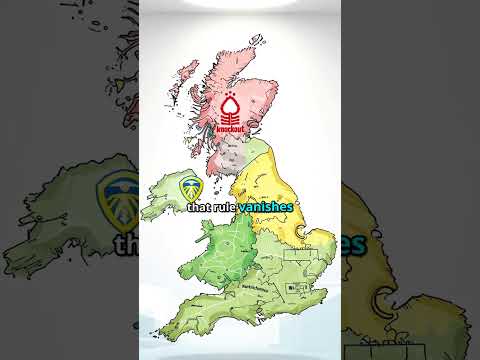
In Rounds One and Two, the draw is geographically divided. Northern clubs face northern clubs. Southern clubs face southern clubs. It keeps travel distances manageable and reduces fixture congestion in a calendar that’s already stretched thin in August.
But the third round tears that boundary down entirely. From that point, any team can face any other team. Arsenal could draw Manchester City. A London club could travel to the north. A newly promoted Championship side could find themselves hosting one of the country’s biggest names on a Tuesday night in September.
Round One of the 2026-27 competition took place across the weekend of 7-9 August 2026. Round Two followed the week commencing 24 August. The third-round draw, completed on August 26 following the conclusion of Preston North End versus Everton, confirmed fixtures scheduled across two separate windows: the weeks commencing 7 September and 14 September.
That split isn’t arbitrary. It’s a direct response to European football.
Why the Champions League Creates a Scheduling Wall
Five Premier League clubs competing in this season’s Champions League cannot play their third-round ties in the first fixture window. European commitments take priority, so they’re pushed into the second week — the window commencing 14 September — to avoid a clash with continental fixtures.
Think about what that does to the draw. You have 32 or so clubs entering Round Three, but five of them are ring-fenced into a specific week. The draw still looks open. The outcomes are shaped by constraints most fans never see.
For a competition that markets itself on unpredictability and giant-killing, this is an honest structural tension. The EFL Cup wants chaos. It also has to function within the realities of modern European football, where Premier League clubs are simultaneously competing across multiple competitions on multiple timelines. Those two things don’t always sit comfortably together — and the third-round scheduling is where that friction becomes visible.
The Moment the Giants Finally Enter
Round Three is also when the Premier League’s heaviest hitters join the competition for the first time. Arsenal. Manchester City. Manchester United. While lower-league clubs have been fighting through Rounds One and Two since early August, the traditional giants have been watching from the sidelines.
That delayed entry is deliberate. The EFL Cup has always tried to balance two competing pressures: giving smaller clubs a genuine path through the early rounds, and ensuring the later stages carry enough star power to sustain audiences and commercial value. Letting the biggest Premier League clubs skip the first two rounds is the compromise that holds those two ideas together.
It also creates a specific kind of drama. A League One or Championship club that has survived two knockout rounds suddenly finds themselves in the same draw as Arsenal or Manchester City. The underdog story that every football fan instinctively roots for isn’t just theoretically possible — it’s structurally guaranteed by how the competition is designed.
Nottingham Forest didn’t make it to that third-round draw. Leeds ended their run earlier. But for every club that did survive to August 26, the draw represented something concrete: they’re now in the same hat as the biggest clubs in English football, with no geographic protection and no scheduling buffer to keep them apart.
Final Thought
The EFL Cup doesn’t get the same reverence as the FA Cup or the Premier League title race — but the structural decisions embedded in its format tell a more interesting story than most people realise. The geographic split that dissolves at Round Three. The scheduling wall that separates Champions League clubs from the first fixture window. The moment Arsenal and Manchester City finally enter, facing opponents who’ve already survived two knockout rounds to get there.
Nottingham Forest’s exit at the hands of Leeds in the 2026-27 competition is a small example of the larger truth: in a single-leg, seven-round format, history and reputation offer zero protection. The draw on August 26 confirmed that. The results in September will prove it again.
Frequently Asked Questions
How many rounds are in the EFL Cup?
The EFL Cup consists of seven rounds with single-leg ties, meaning one loss eliminates a club. The only exception is the semi-finals, which are played over two legs before a neutral venue final.
Are EFL Cup matches home and away or single leg?
Almost all EFL Cup matches are single-leg ties with no replays or second chances, making one bad night enough to end a club’s run. Only the semi-finals use a two-legged home-and-away format.
How does the EFL Cup draw work in the early rounds?
In Rounds One and Two, the EFL Cup draw is split geographically, with northern clubs facing northern clubs and southern clubs facing southern clubs. From the third round onward, this geographic division is removed entirely.
Recommended Reading
Explore these hand-picked resources to dive deeper into this topic:
- Inverting the Pyramid by Simon Kuper
- The Ball is Round by David Goldblatt
- ESPN Films 30 for 30 (Sports Documentary Series)
As an Amazon Associate, we earn from qualifying purchases. This helps support Fact Storm Hub at no extra cost to you.
Sources
- https://efl.com/competitions/carabao-cup
- https://sports.yahoo.com/articles/carabao-cup-third-round-draw-185316414.html
- https://www.the-independent.com/sport/football/carabao-cup-third-round-draw-date-time-watch-b3039337.html
- https://www.bbc.com/sport/football/articles/clyegmmvr4vo
- https://www.chelseafc.com/en/news/article/carabao-cup-third-round-draw-how-to-watch-possible-opponents-ball-numbers
🤖 AI Content Disclosure
This article was created using AI-assisted research and writing tools, then reviewed for quality and accuracy. Facts are sourced from publicly available web research, but readers should verify critical information from primary sources.
Published for educational and entertainment purposes. Last reviewed: August 2026