
Library of Alexandria: 9 Myths You Were Taught Wrong
Library of Alexandria: 9 Myths You Were Taught Wrong
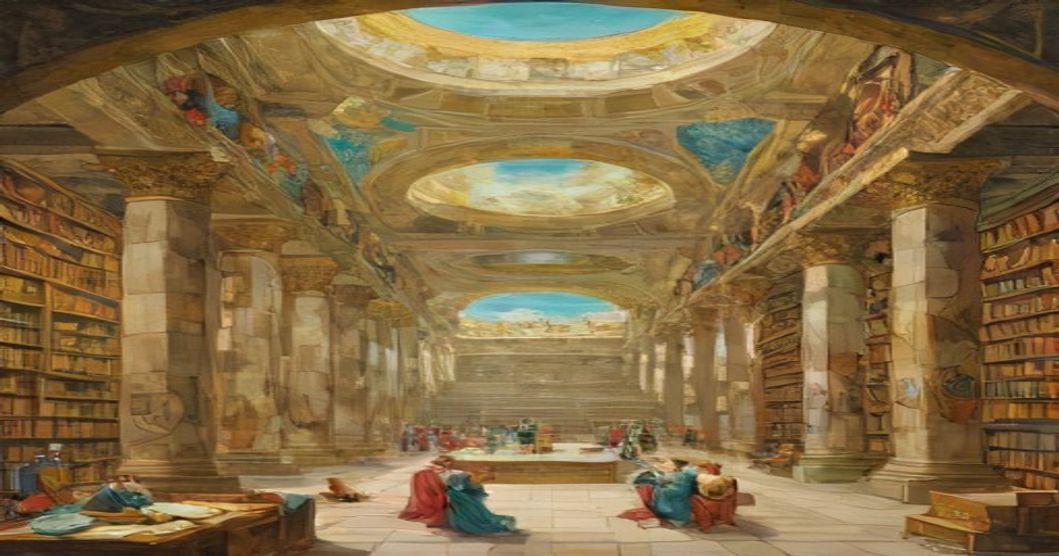
Imagine walking through a corridor where the sunlight, filtered through high-set windows, illuminates not stone or marble, but walls made of stories. To your left, a vast collection of philosophical texts. To your right, the star charts of Hipparchus, mapping constellations no one would properly document again for centuries. This was the Great Library of Alexandria, one of the most celebrated intellectual institutions of the ancient world. It was a place where human thought was gathered and studied — and it has since become one of history’s most mythologized places. But how much of what you “know” about it is actually true?
1. Myth: It Was One Single, Enormous Library
The image most of us carry is vivid and cinematic: one grand, towering building housing all the knowledge of the ancient world. The reality was considerably more complex. The Library of Alexandria was not a single structure but part of a broader institution called the Mouseion — a research complex more akin to a modern university campus than a single reading room. There was also a secondary collection, sometimes called the “daughter library,” housed in the Temple of Serapis (the Serapeum) in a different part of the city. Scholars today emphasize that thinking of “the Library” as one unified building fundamentally misrepresents what it actually was: a sprawling, multi-site intellectual ecosystem.
2. Myth: It Held Half a Million Scrolls or More
Ancient sources give us a dizzying estimate: at its peak, the Library of Alexandria held between 400,000 and 700,000 papyrus scrolls. These numbers have been repeated so often they feel like established fact. But modern historians dispute them significantly. The figures come from ancient sources that were themselves often exaggerating for rhetorical effect, and scholars today are far less confident in any precise number. What we can say is that the collection was undeniably large and impressive for its era — but the half-million-plus figure should be treated with healthy skepticism rather than accepted as gospel.
What is well-documented is the library’s aggressive acquisition policy. Agents of the Ptolemies were dispatched across the Mediterranean, tasked with acquiring — or forcibly copying — any text they could find. Ships docking in Alexandria’s harbor were searched, and any books found were taken to the library, copied by official scribes, and the copies were returned to the owners while the originals were kept. This ambition was real, even if the exact scale remains uncertain.
3. Myth: It Was the First Library of Its Kind
The Library of Alexandria carries such legendary status that many assume it was the world’s first great library — a one-of-a-kind invention that appeared out of nowhere. In fact, it was not. Libraries and organized archives of written knowledge existed long before Alexandria. The ancient Assyrian king Ashurbanipal, for example, assembled a vast library of cuneiform tablets at Nineveh centuries earlier. Authoritative historical sources today are unambiguous on this point: the claim that Alexandria housed the world’s first great library is simply false. Alexandria was extraordinary, but it was built on a tradition of knowledge-keeping that stretched back long before its founding.
4. Myth: Its Books Were Enchanted or Mystically Special
This one might sound too fanciful to take seriously — and yet it persists in popular culture and certain mythological retellings. The legend holds that the Library’s scrolls were somehow magically imbued, containing secret or enchanted knowledge beyond ordinary human understanding. There is no credible historical evidence for this whatsoever. The Library’s scrolls were papyrus documents: remarkable for their content, yes, but entirely mundane in their physical nature. This myth appears to be a later romantic and mythological embellishment, likely born from the Library’s near-mythical reputation rather than anything rooted in historical record.
5. Myth: One Catastrophic Fire Destroyed Everything in an Instant
Perhaps the most dramatic and enduring myth of all: a single, terrible fire swept through the Library and erased centuries of human knowledge in one catastrophic night. It is a compelling image — and almost certainly an oversimplification. The historical record points to multiple incidents of damage over many years, involving different actors at different times. Julius Caesar’s military campaign in 48 BCE is often cited as a key moment, but most historians believe any fire associated with Caesar affected warehouses near the harbor rather than the Library itself. Later damage came during the reign of Aurelian in the 270s CE, and further decline occurred under Theophilus in the late 4th century CE. The Library’s end was likely a slow, painful erosion rather than a single dramatic conflagration.
6. Myth: We Know Exactly Who Destroyed It
Closely related to the fire myth is the question of blame. Depending on who is telling the story, the villain is Julius Caesar, the early Christians, the Roman Emperor Aurelian, or the 7th-century Arab conquest under Caliph Omar. The truth is considerably more uncomfortable for those who want a clean historical narrative: we do not know with certainty. The exact circumstances of how and why the Library declined and was ultimately destroyed remain historically unclear and actively disputed among scholars. Each of the named culprits has some historical basis for suspicion, but none can be definitively proven as the sole destroyer. Assigning confident blame is more about storytelling than scholarship.
7. Myth: Its Destruction Was Purely an Act of War
The assumption that the Library of Alexandria was brought down by conquest, invasion, or deliberate military destruction is a natural one — but it is incomplete. Historians today recognize that the Library’s decline was shaped by forces well beyond the battlefield. Funding cuts, shifting political priorities, the gradual neglect of the Ptolemaic patronage system, and the slow deterioration of institutional support all played significant roles. This is perhaps the Library’s most sobering lesson for the modern world: libraries and centers of knowledge can be destroyed just as effectively through indifference and underfunding as through fire and warfare.
8. Myth: All Its Knowledge Was Lost Forever
The romantic tragedy of the Library’s destruction is often framed as an irreversible catastrophe — a permanent severing of humanity from ancient wisdom. While the loss was undeniably significant, this framing overstates the totality of the damage. Many texts that were housed in Alexandria survived through other means: copies held in other cities, works preserved by Byzantine scholars, and manuscripts transmitted through the Islamic Golden Age’s own extraordinary tradition of scholarship. The destruction of the Library was a serious blow, but human knowledge proved more resilient and redundant than the myth of total loss suggests.
9. Myth: It Was Simply a Library in the Modern Sense
When we hear the word “library” today, we picture a place where books are stored and borrowed. The Library of Alexandria was something far more ambitious. As part of the Mouseion, it functioned as a fully funded research institution — scholars were housed, fed, and paid to conduct research there. It was simultaneously a library, a university, a research laboratory, and a center for translation and textual criticism. Thinkers including Euclid, Archimedes, and Eratosthenes — who famously calculated the circumference of the Earth with remarkable accuracy — were connected to this institution. Calling it simply a “library” undersells what it actually represented: one of the ancient world’s most deliberate and ambitious attempts to systematize human knowledge.
The Library of Alexandria endures in our imagination precisely because it represents something we still care deeply about: the fragility and resilience of knowledge. The myths surrounding it say as much about us as they do about the ancient world. Understanding what it actually was — complex, imperfect, and extraordinary — is far more interesting than the legend.
Recommended Reading
Explore these hand-picked resources to dive deeper into this topic:
- The Story of Civilization by Will Durant
- Lost Civilizations by David Hatcher Childress
- Ancient Egypt Documentary Series (historical video collection)
As an Amazon Associate, we earn from qualifying purchases. This helps support Fact Storm Hub at no extra cost to you.
Share this story
🤖 AI Content Disclosure
This article was created using AI-assisted research and writing tools, then reviewed for quality and accuracy. Facts are sourced from publicly available web research, but readers should verify critical information from primary sources.
Published for educational and entertainment purposes. Last reviewed: April 2026