
China’s Deepest Sinkhole: Lost World Discovered
China’s Deepest Sinkhole: Lost World Discovered
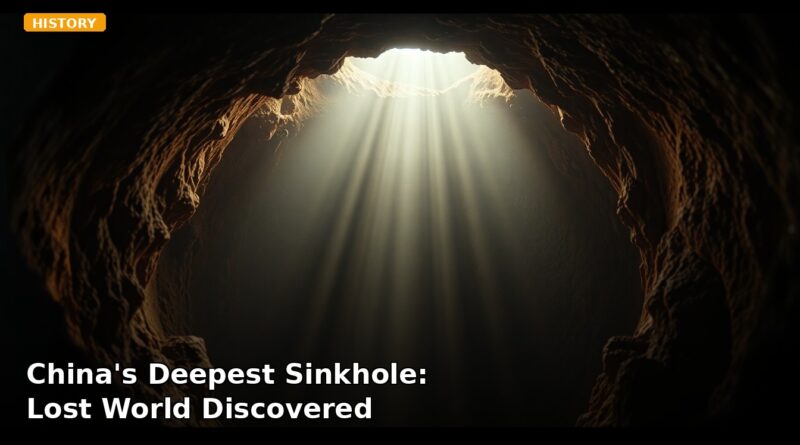
A hole in the ground in Chongqing, China is so deep that if you dropped the Eiffel Tower inside it, the tip wouldn’t reach the rim. At the bottom, sealed off from the rest of the planet, something extraordinary is growing — and it took the outside world until 1994 to even know this place existed.
Xiaozhai Tiankeng — China’s colossal “Heavenly Pit” — is back in global conversations. But the story behind this world record landmark goes far deeper than any headline. This isn’t just about a sinkhole. It’s about a hidden civilization of plants, a predator that shouldn’t be there, and a staircase that has no business existing.
The Hole That Shouldn’t Exist
Start with the numbers, because the numbers are the first thing that breaks your brain.
Xiaozhai Tiankeng is 626 meters long, 537 meters wide, and between 511 and 662 meters deep — with walls that drop almost perfectly vertical. To put that depth in terms you can actually picture: the deepest point is taller than two Empire State Buildings stacked on top of each other.
But the shape is what makes it truly strange. This isn’t a simple bowl carved into the earth. Xiaozhai Tiankeng has a double-nested structure — an upper bowl 320 meters deep, and a lower bowl 342 meters deep, the two connected by a sloping ledge of soil trapped in the surrounding limestone. Stand at the rim and you’re not looking straight down to the bottom. You’re looking into one abyss that opens into another.
The mechanics behind its formation are equally dramatic. Beneath the sinkhole runs the Difeng cave system, carved out over millennia by a powerful underground river that still flows there today. As that river eroded the limestone from below, the ceiling eventually became too thin to support itself. What you see now is the result of that ceiling collapsing inward — not once, but in stages, which is why the nested structure exists at all. Ancient civilizations built myths around far less.
The Name the Locals Always Knew
Here’s what the “discovery” story usually leaves out: nobody discovered this.
Fengjie County locals had been living alongside Xiaozhai Tiankeng for centuries. The name itself is proof. “Xiaozhai” refers to a small village that once sat near the rim — the Chinese characters translate simply as “little village.” “Tiankeng” is a regional term used in this part of China specifically to describe these kinds of massive karst sinkholes, meaning “Heavenly Pit.” The language already existed because the people already knew.
What happened in 1994 was not discovery. It was introduction. British explorers attempting to survey the underground cave system below the sinkhole brought it to the attention of the wider scientific and geographic world. For Western cartographers and record-keepers, it was new. For the families who had farmed and built lives near its rim for generations, it was simply the pit at the edge of the village — enormous, permanent, and entirely ordinary in the way that only ancient things can become ordinary.
This gap between local knowledge and official recognition is a pattern that runs through the history of geography. The world’s most dramatic natural features are rarely “found.” They are formally acknowledged, sometimes centuries late.
What’s Living at the Bottom
Cold statement of fact: the bottom of Xiaozhai Tiankeng is not dead. It is one of the most biologically dense micro-environments on the planet.
More than 1,200 plant species have been recorded inside the sinkhole. The depth and the vertical walls create a sealed climate — protected from wind, accumulating moisture, catching just enough light at certain angles — that functions almost like a greenhouse the size of a small city. Ancient trees grow at the base. Ferns colonize the ledge between the two bowls. Species that have disappeared from the surrounding landscape still thrive here, undisturbed, because nothing and no one could easily reach them.
And then there is the clouded leopard.
The clouded leopard is one of the most elusive wild cats in Asia — a medium-sized predator with a coat pattern that reads like a map of ancient forests, capable of descending trees headfirst, rarely photographed in the wild. Evidence suggests clouded leopards inhabit the sinkhole ecosystem. What that means in practice is that a functional predator-prey food chain exists at the bottom of a hole so deep that standing at the rim, you cannot see the floor on overcast days. The sinkhole didn’t just preserve plants. It preserved the things that eat them.
This is what makes Xiaozhai Tiankeng genuinely different from other geography world records. It isn’t just the largest or the deepest. It is ecologically isolated in a way that almost no other place on Earth is — a vertical island, surrounded not by water but by hundreds of meters of open air.
The Staircase Nobody Talks About
Someone built a 2,800-step staircase inside the world’s deepest sinkhole. That sentence deserves a moment. To make this place accessible to visitors, engineers and construction workers descended into a vertical pit the depth of two Empire State Buildings stacked on top of each other and installed a staircase long enough that climbing it would leave most people unable to walk the next morning. The logistics alone — moving materials, anchoring steps into limestone walls that curve inward, building in sections that account for the double-bowl structure — represent an engineering problem with almost no precedent.
The staircase is now how tourists experience Xiaozhai Tiankeng. You descend into the upper bowl, pass the ledge, and continue into the lower bowl, the walls rising around you until the rim above is a distant rectangle of sky. The underground river that carved this entire structure can be heard before it can be seen — a reminder that the force that built this place is still at work, still moving, still dissolving the limestone millimeter by millimeter beneath your feet.
Most visitors, reportedly, do not attempt the full descent and return in a single trip. That detail alone tells you something the dimensions cannot.
A World Record That Earns the Title
World records in geography are usually just superlatives — the longest, the tallest, the widest. They impress for a moment and then blur into a list. Xiaozhai Tiankeng is different because the record is almost beside the point.
Yes, it is the world’s deepest sinkhole, with a verified depth of up to 662 meters. Yes, the double-nested structure is geologically unique. But what the numbers cannot capture is what the place actually is: a sealed world that formed independently, preserved species that vanished elsewhere, and harbored a functioning ecosystem at the bottom of a vertical cliff face — all while the village above it went about ordinary life for centuries, treating the abyss next door as simply part of the landscape.
The outside world needed explorers and surveys and formal recognition to understand what it was looking at. The locals just called it the pit at the edge of the village. Both perspectives are true. Only one of them required a 2,800-step staircase to get there.
Frequently Asked Questions
How deep is China’s Xiaozhai Tiankeng sinkhole?
Xiaozhai Tiankeng is between 511 and 662 meters deep, making it deeper than two Empire State Buildings stacked on top of each other. Its length measures 626 meters and its width 537 meters.
Where is the world’s deepest sinkhole located?
The world’s deepest sinkhole, Xiaozhai Tiankeng, is located in Chongqing, China. Known as the ‘Heavenly Pit,’ it remained unknown to the outside world until 1994.
How was the Xiaozhai Tiankeng sinkhole formed?
Xiaozhai Tiankeng formed when an underground river eroded the limestone beneath it over millennia, causing the ceiling to collapse inward in stages. This process created its unique double-nested bowl structure.
Recommended Reading
Explore these hand-picked resources to dive deeper into this topic:
- The Lost City of the Monkey God by Douglas Preston
- Caves of Ice by William C. Dietz
- National Geographic Explorer Fossil Dig Kit
As an Amazon Associate, we earn from qualifying purchases. This helps support Fact Storm Hub at no extra cost to you.
Sources
- https://en.wikipedia.org/wiki/Xiaozhai_Tiankeng
- https://www.discoverwildlife.com/environment/deepest-sinkhole-xiaozhai-tiankeng
- https://www.bbc.com/travel/article/20221117-xiaoxhai-tiankeng-the-worlds-biggest-sinkhole
- https://www.bbc.com/reel/video/p0crc7bb/watch
- https://www.youtube.com/watch?v=7-3BQg3ua10
Watch the Video
🤖 AI Content Disclosure
This article was created using AI-assisted research and writing tools, then reviewed for quality and accuracy. Facts are sourced from publicly available web research, but readers should verify critical information from primary sources.
Published for educational and entertainment purposes. Last reviewed: April 2026