
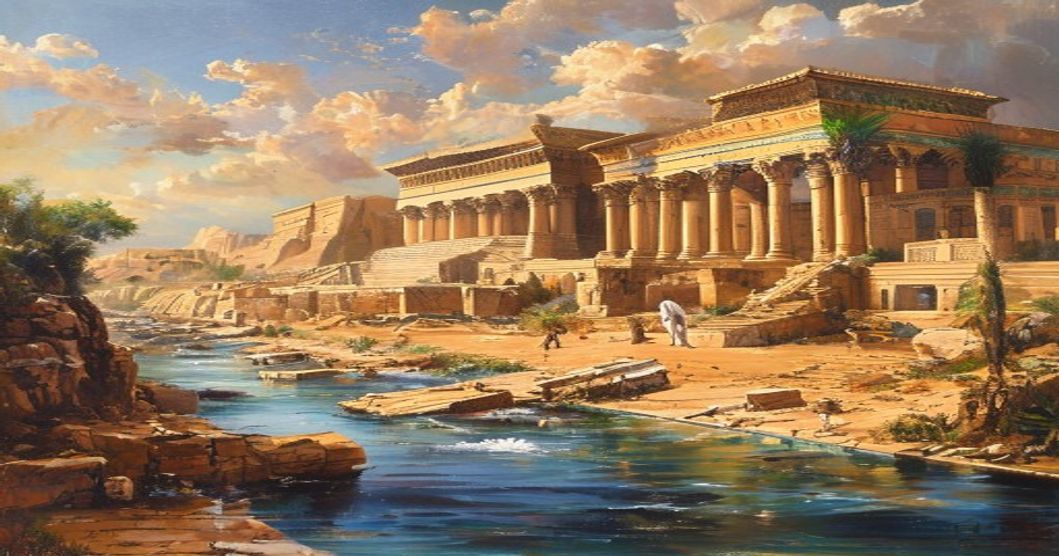
Ancient Alexandria’s Shocking 500-Year Decline Explained
Ancient Alexandria’s Shocking 500-Year Decline Explained
Imagine the scent of parchment and papyrus, the hushed reverence of scholars, the towering shelves holding the accumulated knowledge of the ancient world. For centuries, this image of the Library of Alexandria has captivated our imaginations, often ending in a single, tragic blaze. We picture a catastrophic fire, a sudden, brutal end to civilization’s greatest archive. But modern historical research is storming through that long-held myth, revealing a truth far more complex, more drawn out, and ultimately, more haunting: the Library’s destruction wasn’t one fire, but a 500-year process of multiple burns, neglect, and political turmoil, starting with none other than Julius Caesar himself. And crucially, by the time the final blows came, the Library was already a shadow of its former self — hollowed out by funding failures, political purges, and institutional decay long before any flames arrived. This isn’t just a correction; it’s a profound retelling of one of history’s most significant losses, proving that even the most iconic stories can be dramatically reshaped by new evidence.
1. Alexandria Was Built to Dominate the Ancient World
Before we can understand how Alexandria fell, we must understand what it was built to be. Founded by Alexander the Great himself, Alexandria was conceived from its very inception as a major trade hub — a city designed to sit at the crossroads of civilizations, channeling the wealth of the Mediterranean, Africa, and the East through a single, magnificent port. Alexander’s vision was staggering in its ambition: not merely a military outpost or administrative center, but a living monument to Greek culture and commerce transplanted onto Egyptian soil. The city’s legendary harbor, its towering Pharos lighthouse — one of the Seven Wonders of the Ancient World — and its grid-planned streets were all expressions of this founding ambition. The Library itself grew organically from this spirit of cosmopolitan accumulation. If Alexandria was to be the world’s greatest trading city, its Ptolemaic rulers reasoned, it should also be the world’s greatest city of knowledge. Understanding this founding DNA is essential, because it means that when Alexandria’s trade networks weakened and its political masters struggled, every institution within the city — including the Library — felt the tremors.
2. The Spark in Caesar’s War: A Misunderstood Catastrophe
The year is 48 BCE. Julius Caesar, fresh from his decisive victory at Pharsalus, finds himself entangled in a bitter dynastic struggle in Egypt, supporting Cleopatra against her brother Ptolemy XIII. The Roman general’s forces were outnumbered, his position precarious. To prevent Ptolemy’s fleet from cutting off his escape or reinforcements, Caesar made a desperate tactical decision: he ordered the burning of the Egyptian ships docked in Alexandria’s harbor. What followed was an inferno, a raging conflagration that swept through the wharves and warehouses, an unintended consequence of military necessity. For generations, this event has been painted as the singular, devastating moment when the Great Library perished, a testament to Roman indifference or accidental destruction.
But the real history is far more nuanced. While Caesar’s fire undoubtedly caused immense damage during a period of significant Egyptian civil unrest, consuming docks and nearby structures, it did not annihilate the entire Library. Contemporary accounts, and later historical evidence, strongly suggest that the main research institution — the Mouseion, which housed the Library — continued to exist and function after this incident. What likely burned were vast quantities of scrolls stored in adjacent warehouses or on the quays, perhaps awaiting cataloging or shipment. Consider the staggering scale of what was at risk: at its peak, the Library of Alexandria is estimated to have held as many as 500,000 scrolls, representing the accumulated intellectual output of the ancient world across science, philosophy, literature, and medicine. This initial blaze was a colossal blow, a tragic loss of countless unique texts — but it was only the first chapter of a much longer story of decline.
3. The Purge That Preceded the Flames: How Politics Gutted the Library First
Here is where modern research delivers one of its most striking revelations, and one that fundamentally reframes the entire narrative. The Library of Alexandria did not fall at its peak. By the time its final destruction came, it had already been significantly weakened — not primarily by fire, but by politics. The decline of the Library’s influence began, historians now emphasize, with a systematic purging of intellectuals from the city. When the political winds shifted and the Ptolemaic government’s patronage faltered, the great minds who had made the Library the beating heart of ancient scholarship were driven out, scattered across the Mediterranean world. Without its scholars, the Library was no longer a living, breathing institution of inquiry — it was increasingly just a collection of aging scrolls in aging buildings, with fewer and fewer hands capable of maintaining, cataloging, or expanding it.
This pattern — the brain drain preceding the physical destruction — is a sobering reminder that institutions die from the inside out. The Library’s intellectual decline was well underway before any conqueror arrived to deliver a final blow. The loss of funding from a struggling Ptolemaic government compounded the crisis. Without royal patronage, acquisitions slowed, maintenance lapsed, and the Library’s legendary ambition to collect a copy of every book in the world became an increasingly hollow aspiration. The fire that history remembers was, in many ways, merely the visible punctuation mark at the end of a sentence that had been slowly, painfully written over generations.
4. Five Centuries of Slow Erosion: Why the “One Fire” Myth Gets It So Wrong
Perhaps the most important insight that modern historical research has delivered is this: the Library of Alexandria declined gradually over approximately 500 years, not in a single catastrophic event. This is not a minor revision — it is a complete overturning of the popular narrative. The 500-year timeline stretches from Caesar’s harbor fire in 48 BCE through a succession of damaging episodes: the violence during Aurelian’s recapture of Alexandria in 270s CE, the destruction of the Serapeum — which housed a significant daughter library — under the Christian emperor Theophilus in 391 CE, and the Arab conquest of Egypt in 642 CE, which has also been blamed, with varying degrees of historical justification, for further losses.
Each of these events contributed to the Library’s erosion, but none of them alone constitutes “the” destruction. More importantly, the periods between these dramatic events were equally damaging in their quieter way — years and decades of underfunding, neglect, political instability, and the slow physical deterioration of buildings and scrolls. Libraries, as historians now stress, typically decline slowly over time rather than ending in sudden disasters. The Library of Alexandria is the ultimate proof of this principle. It is a story not of one catastrophic night, but of five centuries of accumulated loss — each generation inheriting a slightly diminished institution, each crisis leaving it a little less capable of recovery, until what remained was too fragile to survive at all.
5. Alexandria Today: The Decline That Never Really Stopped
There is a haunting postscript to this story that lends it an almost eerie contemporary resonance. The city of Alexandria itself, in 2026, is experiencing its own slow, grinding decline — one that mirrors, in striking ways, the gradual erosion of its ancient institutions. Modern Alexandria is, quite literally, sinking and crumbling under its own weight. Slow geological forces, combined with structural deterioration of the city’s aging physical infrastructure, are causing the ground beneath Alexandria to subside. Buildings crack. Coastal areas face increasing pressure. The city that Alexander the Great built to last forever is being quietly reclaimed by the earth and the sea.
This is not merely a poetic metaphor. It is a concrete, measurable phenomenon that urban planners and geologists are grappling with in real time. And it serves as a powerful reminder of the central lesson of the Library’s story: great things rarely end with a bang. They end with a long, slow diminishment — a series of small failures, each one manageable in isolation, each one slightly harder to recover from than the last, until one day the weight of accumulated loss becomes too great to bear. Alexandria has lived this story twice now. The first time, it lost its Library. The second time, it may be losing the city itself. The 500-year decline of the ancient world’s greatest archive was not an anomaly. It was a template.
*The story of the Library of Alexandria is ultimately a story about how civilization sustains — or fails to sustain — the institutions it builds. The myth of the single catastrophic fire is comforting in its simplicity: it gives us a villain, a moment, a
Recommended Reading
Explore these hand-picked resources to dive deeper into this topic:
- The Rise and Fall of Alexandria by Justin Pollard
- 1491: New Revelations of the Americas Before Columbus by Charles C. Mann
- Ancient Egypt Documentary Series (historical video collection)
As an Amazon Associate, we earn from qualifying purchases. This helps support Fact Storm Hub at no extra cost to you.
Share this story
🤖 AI Content Disclosure
This article was created using AI-assisted research and writing tools, then reviewed for quality and accuracy. Facts are sourced from publicly available web research, but readers should verify critical information from primary sources.
Published for educational and entertainment purposes. Last reviewed: April 2026