
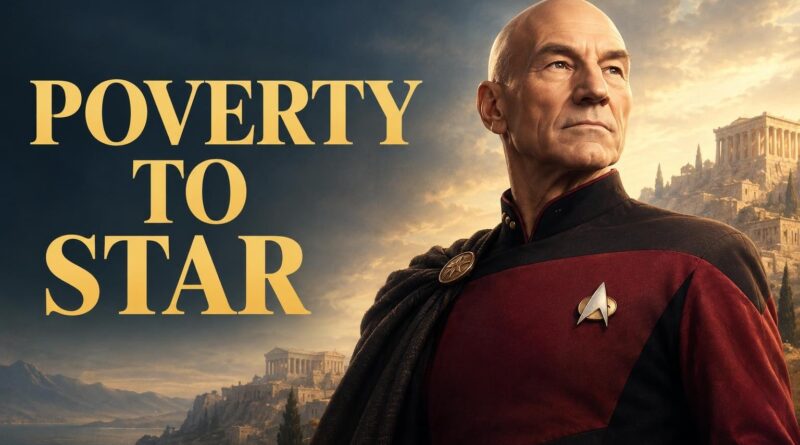
Patrick Stewart: From Poverty to Star Legend
Patrick Stewart: From Poverty to Star Legend
Patrick Stewart — Captain Jean-Luc Picard, Professor Charles Xavier, one of the most commanding presences in the history of film and television — has died at the age of 86. The tributes came fast: Hugh Jackman, William Shatner, George Takei, Ian McKellen. When the people who knew him best are the first to speak, that tells you something about the kind of man he was.
But here’s what the headlines won’t tell you: Patrick Stewart’s story is not a story about fame. It’s a story about a man who built two entirely separate cultural legacies — decades apart — and made both of them unforgettable.
The Captain Everyone Underestimated
Before Patrick Stewart became the face of Star Trek, the casting decision was considered a mistake by almost everyone watching.
A Shakespearean stage actor. British. Bald. Playing the captain of humanity’s most famous starship? Fans were skeptical. Some were furious. The original Star Trek had given the world James T. Kirk — brash, physical, American. Stewart’s Jean-Luc Picard was something else entirely: cerebral, measured, philosophical. A captain who solved problems with his mind before he ever raised his fists.
The skeptics were wrong. Picard didn’t just work — he redefined what a hero could look like on screen. Stewart brought a gravity to the role that turned science fiction into something closer to literature. He made you believe that in the future, humanity had actually grown up.
What makes this remarkable is the context. Stewart came from the Royal Shakespeare Company. He had spent years performing the hardest dialogue ever written for the English stage. When he brought that discipline to a television set, the result was a character that audiences didn’t just enjoy — they trusted. That trust is rare. It’s rarer still when it spans generations. He returned to the role in a later series, giving an entirely new generation their first encounter with that voice, that bearing, that particular kind of quiet authority.
What Happens When Two Captains Sit Down Together
Stewart and William Shatner — the two men who most completely defined what a Star Trek captain looks like — appeared together in a documentary called The Captains. Two actors. Two eras. Two entirely different philosophies of leadership poured into the same fictional chair.
Shatner’s Kirk was instinct and charisma — a man who trusted his gut in the dark and swung first. Stewart’s Picard was reason and restraint — a man who would rather talk an enemy into surrender than fire a single shot. The documentary put those two philosophies in direct conversation, asking openly what those roles had meant to the men who played them and what they had demanded in return.
That is not a routine celebrity project. It is something rarer: two performers reckoning honestly with the weight of what they built. Shatner paid tribute to Stewart following his passing, and those words land differently when you know the two men had already shared that kind of candid, searching conversation on camera long before condolences were necessary.
The Professor Who Refused to Be a Prop
Consider what the role of Professor Charles Xavier could have been in lesser hands: a wise old man in a wheelchair, present to deliver instructions and then move aside while younger, more physically dynamic heroes carried the story.
Stewart refused to let that happen. He played Xavier as a man carrying genuine contradictions — enormous power alongside profound limitation, unshakeable hope alongside deep personal pain. The character became synonymous with his name in a way that made every subsequent interpretation of Xavier answerable to what Stewart had established first.
Ian McKellen, his co-star across multiple X-Men films, was among the first to pay tribute following Stewart’s passing. The two men shared a friendship that extended far beyond any set, and their on-screen dynamic — Xavier and Magneto, two old friends on opposite sides of an impossible argument — became one of the most compelling relationships in modern blockbuster cinema. That chemistry does not happen by accident. It happens when two actors of equal discipline and equal commitment decide to take the material seriously. Stewart took it seriously. Every time.
The Tributes That Mean Something
Not all celebrity tributes are equal. Some are obligation. Some are publicity. And some come from people who understood, from the inside, exactly what was lost.
Hugh Jackman’s tribute to Stewart falls into that third category. Jackman played Wolverine across the same X-Men films where Stewart defined Xavier — they shared scenes, shared sets, and shared the particular experience of watching a franchise grow from a gamble into a cultural institution. When Jackman speaks about Stewart, he is not speaking as a distant admirer. He is speaking as someone who watched the man work up close.
The same is true of George Takei, who understood from his own experience what it means to be part of the Star Trek world across generations. And of Ian McKellen, whose words about his co-star carry the weight of a friendship built over years and tested on screen in front of millions of people.
These are not routine condolences. They are the words of people who knew what Patrick Stewart gave — and who understood, better than most, how difficult it is to give it.
Final Thought
Two universes. Two generations of audiences. One man who never once treated either as anything less than worthy of his full commitment. Patrick Stewart did not stumble into cultural significance — he earned it, role by role, scene by scene, with the discipline of someone who had spent a lifetime learning how to make words matter. The tributes this week are many. They are deserved. And they are, in the end, the clearest measure of a career that asked everything and gave back more.
Frequently Asked Questions
How old was Patrick Stewart when he died?
Patrick Stewart died at the age of 86. His passing prompted an outpouring of tributes from close friends and colleagues including Hugh Jackman, Ian McKellen, William Shatner, and George Takei.
Why was Patrick Stewart’s casting as Captain Picard controversial?
Fans were skeptical and some were furious because Stewart was a British Shakespearean stage actor who was bald, seen as a stark contrast to the brash, physical, American energy of the original Captain Kirk.
What made Patrick Stewart’s portrayal of Jean-Luc Picard so iconic?
Stewart brought discipline from the Royal Shakespeare Company to the role, creating a cerebral, philosophical captain who earned deep audience trust. He later reprised the role in a new series, introducing Picard to an entirely new generation.
Recommended Reading
Explore these hand-picked resources to dive deeper into this topic:
- Making It So by Patrick Stewart
- Star Trek: The Next Generation – The Complete Series (Blu-ray Collection)
- Shakespeare Complete Works (Annotated Edition)
As an Amazon Associate, we earn from qualifying purchases. This helps support Fact Storm Hub at no extra cost to you.
Sources
- https://www.kcra.com/article/hugh-jackman-william-shatner-george-takei-paying-tribute-patrick-stewart/74288291
- https://www.telegraphindia.com/entertainment/patrick-stewart-dies-at-86-x-men-co-stars-hugh-jackman-william-shatner-pay-tribute/cid/2186988
- https://www.ndtv.com/entertainment/patrick-stewart-wore-his-heart-on-his-sleeve-hugh-jackman-ian-mckellen-william-shatner-remember-x-men-star-12256962
- https://www.goldderby.com/tv/2026/william-shatner-hugh-jackman-patrick-stewart-tributes/
🤖 AI Content Disclosure
This article was created using AI-assisted research and writing tools, then reviewed for quality and accuracy. Facts are sourced from publicly available web research, but readers should verify critical information from primary sources.
Published for educational and entertainment purposes. Last reviewed: November 2026