
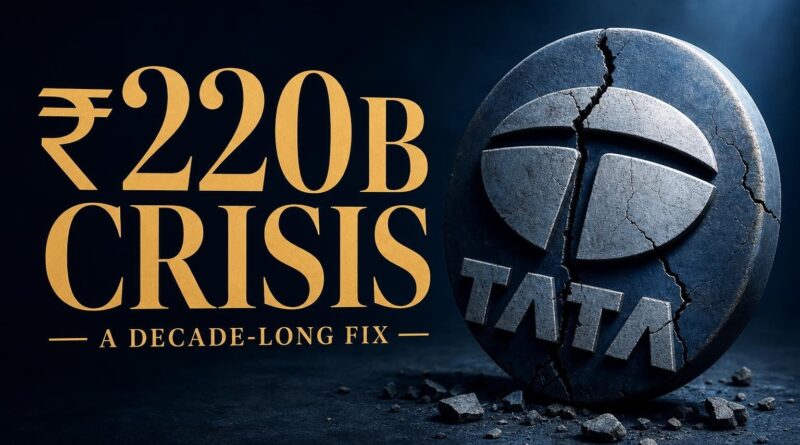
Tata Group’s ₹220B Crisis: A Decade-Long Fix
Tata Group’s ₹220B Crisis: A Decade-Long Fix
Today — July 29, 2026 — is the 122nd birth anniversary of JRD Tata, one of the most celebrated names in Indian business history. And on the very day India remembers him, the conglomerate he helped build is facing its most public financial headache in years: Air India is bleeding money, and the losses are larger than almost anyone expected.
But to understand why this matters, you have to understand what the Tata Group actually is — because most people know the name without knowing the scale.
An Empire Built in 1868
Jamsetji Nusserwanji Tata was 29 years old when he set up a trading firm in Mumbai in 1868. That’s younger than most people are when they get their first promotion.
What followed over the next 158 years is one of the most remarkable stories in global business. Today, the Tata Group generates ₹16.24 trillion — roughly US$170 billion — in annual revenue. Its combined market capitalisation stood at $328 billion as of March 2025. It employs more than 1,151,353 people. That’s not a typo. Over one million people wake up every morning and go to work for a company that started as a single trading firm in colonial-era Bombay.
To put that workforce number in perspective: most countries have armies smaller than Tata’s payroll.
And yet, in 2026, Tata is India’s Most Valuable Brand — retaining its No. 1 rank in the Brand Finance India 100 report with a brand value of US$33.6 billion. The numbers are extraordinary. Which makes the Air India situation all the more striking.
The ₹220 Billion Question
When Tata acquired Air India, it was treated as a homecoming. Tata had originally founded Air India decades ago before the government nationalised it. Getting it back felt like a story with a clean, satisfying ending.
It hasn’t worked out that way — at least not yet.
Tata Group has reported an INR 220 billion loss for Air India. The reasons are a familiar combination of brutal economics: supply chain disruptions, high fuel costs, and crash-related claims. Aviation is one of the few industries where you can do almost everything right and still lose staggering amounts of money because global oil prices moved the wrong way.
Here is the part that should stop you mid-scroll: Tata Sons has said the turnaround could take up to a decade.
A decade. From a group that generates $170 billion in annual revenue, that statement is not pessimism — it is honesty about how difficult airline economics actually are. Air India isn’t just losing money; it is losing money in a sector where even the world’s best-run carriers operate on margins thinner than a boarding pass.
What ₹220 Billion Actually Means Against ₹1.71 Trillion
Numbers this large are easy to read and hard to feel. So here is a way to make the Air India loss concrete.
Tata Group’s net income in 2026 is ₹1.71 trillion — US$18 billion. That means the Air India loss of ₹220 billion represents roughly 13 percent of the group’s total net income. It is not an existential wound. But it is not a rounding error either. It is the kind of number that demands a boardroom answer every single quarter.
What makes the loss particularly hard to absorb is its compounding nature. Supply chain disruptions inflate maintenance and parts costs. High fuel prices compress margins on every flight operated. Crash-related claims introduce unpredictable liability exposure that cannot be planned away. These are not problems that respond to a single strategic fix — they are structural headwinds that must be endured as much as managed.
That is precisely why Tata Sons’ own estimate puts the turnaround timeline at up to a decade. The group is not guessing. It is telling the market that airline economics are brutal enough that even a conglomerate of this scale, with this much capital behind it, cannot simply spend its way to profitability overnight. The honesty of that statement is, in its own way, more reassuring than false confidence would be.
The Structure That Makes Tata Different
66% of Tata Sons — the holding company that controls the entire group — is owned by Tata Trusts, not by shareholders chasing quarterly returns. Those trusts exist to promote education, health, culture, and livelihood initiatives across India.
This single structural fact explains more about Tata’s longevity than any strategy document ever could. When the majority owner of your holding company is a charitable trust, the incentives at the top of the organisation are fundamentally different from a typical corporation. Short-term losses in a sector like aviation don’t automatically trigger a fire sale — because the people with ultimate ownership are not primarily motivated by this quarter’s share price.
That structure is also why Tata can absorb a ₹220 billion Air India loss without the kind of panic that would shutter a smaller company. The foundation is deep enough to carry the weight, and the ownership is patient enough to let a decade-long turnaround actually play out across a decade.
What JRD Tata Would Have Said
JRD Tata built Air India into one of Asia’s finest carriers. He was known for obsessing over the passenger experience — reportedly checking seat cleanliness personally on flights. Under his stewardship, the airline was a source of genuine national pride.
Then the government nationalised it. Decades of state ownership followed, and what had been a world-class carrier slowly became something else: ageing aircraft, a damaged reputation, a workforce culture that had calcified under bureaucratic management. When Tata reacquired Air India, it wasn’t inheriting JRD’s airline. It was inheriting the wreckage of what that airline had been allowed to become.
The ₹220 billion loss is, in that sense, the price of restoration — the cost of attempting to return something to what it once was after it was allowed to deteriorate for a generation. JRD Tata built it. The state eroded it. Tata is now trying to rebuild it.
On his 122nd birth anniversary, that circularity is the whole story. The founder’s name is on the airline again. The work of making that mean something — of closing the gap between the legend and the current reality — is what the next decade is actually for.
Frequently Asked Questions
How much money has Air India lost under Tata Group?
Tata Group has reported an INR 220 billion loss for Air India since acquiring it. The losses are described as larger than almost anyone expected, driven by a combination of brutal economic challenges.
Why did Tata Group buy Air India?
Tata Group’s acquisition of Air India was seen as a homecoming, since Tata had originally founded the airline before the government nationalised it. Regaining ownership felt like a natural and satisfying return to its roots.
How big is the Tata Group in 2025?
Tata Group generates ₹16.24 trillion (approximately US$170 billion) in annual revenue, has a market capitalisation of $328 billion, and employs over 1.15 million people, making it India’s most valuable brand worth US$33.6 billion.
Recommended Reading
Explore these hand-picked resources to dive deeper into this topic:
- The Tatas: How a Family Built a Business Empire by Girish Kuber
- India’s Struggle for Independence by Ramachandra Guha
- Infosys: The Narayana Murthy Years (Documentary Series)
As an Amazon Associate, we earn from qualifying purchases. This helps support Fact Storm Hub at no extra cost to you.
Sources
- https://en.wikipedia.org/wiki/Tata_Group
- https://www.tata.com/home-page
- https://www.tata.com/about-us
- https://in.linkedin.com/company/tata-group
- https://www.tata.com/investors/companies
🤖 AI Content Disclosure
This article was created using AI-assisted research and writing tools, then reviewed for quality and accuracy. Facts are sourced from publicly available web research, but readers should verify critical information from primary sources.
Published for educational and entertainment purposes. Last reviewed: July 2026