
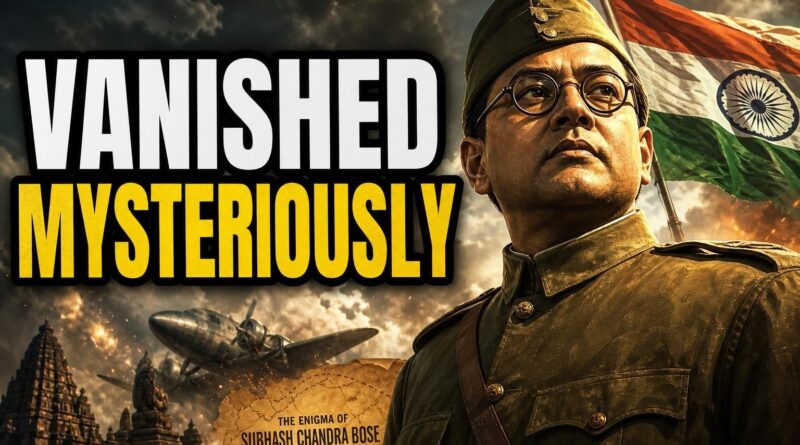
Subhash Chandra Bose: India’s Most Controversial Hero
Subhash Chandra Bose: India’s Most Controversial Hero
This week, a BJP Rajya Sabha MP lost a prestigious state award — the Banga Bibhushan — after claiming that Subhash Chandra Bose didn’t actually build the Azad Hind Fauj. That the army was, in his words, a unit of British soldiers all along.
Within days, opposition parties condemned the remarks. A section of the BJP itself distanced from them. The West Bengal government stripped the award. An FIR was filed. The MP publicly apologized.
One man’s comments about a figure who died decades ago managed to unite political opponents, fracture a ruling party, and trigger a legal case — all in the same week.
That doesn’t happen unless the person at the center of the storm means something extraordinary. So who was Subhash Chandra Bose, really? And why does his story still have the power to ignite an entire country?
The Man Who Chose a Different Path
Most freedom fighters of Bose’s era chose negotiation. Petitions. Peaceful resistance. Bose chose something else entirely.
He wasn’t always the radical. He topped the Indian Civil Service examination — one of the hardest tests in the British Empire — which meant a guaranteed career, status, and comfort. He resigned anyway. That decision alone tells you everything about who he was.
Bose believed that the British would never leave India because someone asked politely. He believed they would leave only when it became too costly to stay. That conviction put him on a collision course not just with the British, but with the mainstream of India’s own independence movement.
He was elected President of the Indian National Congress — twice. The second time, he ran against a candidate backed by Mahatma Gandhi himself, and won. The tension that followed was so severe that Bose eventually resigned and formed his own organization. He wasn’t pushed out. He walked out, because he believed the movement needed a harder edge.
That willingness to break from consensus — even when the consensus was Gandhi — is what made Bose one of the most singular figures in Indian history. And it’s what makes the argument about his legacy so heated, even now.
The Army That Started a War of Words
The Azad Hind Fauj — the Indian National Army — is the specific flashpoint in this week’s controversy. Ananta Maharaj, the BJP MP from Cooch Behar, claimed at a GCPA workers’ meeting in Dinhata-II block that Bose “did not have the capability to organise and raise an army” like the INA, and that it was actually a unit of British soldiers.
The claim collapsed almost immediately under the weight of its own contradiction. The INA was formed to fight against the British, recruiting from Indian prisoners of war and the Indian diaspora in Southeast Asia. Its entire purpose was the armed liberation of India. Calling it a British unit is a bit like calling the French Resistance a German operation.
The backlash was swift and came from every direction. Opposition parties in West Bengal condemned the remarks. A section of the BJP itself publicly distanced from Maharaj. The West Bengal government revoked his Banga Bibhushan award — one of the state’s highest civilian honours. An FIR was filed against him. He eventually apologized, and Bengal BJP softened its public stance after the apology.
What the episode revealed is something deeper than one MP’s poor word choice: Bose is not a neutral historical figure in India. He is sacred ground. And the speed of the backlash — from all sides of the political spectrum — tells you exactly how sacred.
Why Bose Became Untouchable as a Symbol
Subhash Chandra Bose occupies a unique space in Indian memory that very few historical figures anywhere in the world can claim. He is simultaneously claimed by the left and the right, by Bengal and by the nation, by those who believe in armed struggle and those who simply admire personal courage.
Part of the reason is that his story is unfinished in a way that most historical figures’ stories are not. The circumstances of his death remain disputed. There was no clean ending, no final chapter that could be used to define him in one direction or another. That ambiguity has kept his legacy permanently alive and permanently contested.
Part of it is also the sheer scale of what he attempted. He traveled across occupied Europe during the Second World War, reached Southeast Asia, and built a military force from scratch — recruiting Indian prisoners of war, raising funds, and coordinating with foreign powers — all in pursuit of a single goal: ending British rule in India. Whether you agree with his methods or not, the ambition was extraordinary.
And part of it is simply Bengal. Bose was born in Cuttack but is claimed most fiercely by Bengal, where he is known as Netaji — “respected leader.” In Bengal’s political culture, an attack on Bose is not a historical disagreement. It is a personal insult to millions of people. The Dinhata-II incident, roughly 40 kilometres from Cooch Behar town, erupted in a region where that emotional connection runs especially deep.
What the Controversy Actually Reveals
Cold statement of fact: a single MP’s remarks, made at a local party meeting, triggered a state government award revocation, a police case, a national news cycle, and an apology — all within days.
That sequence is worth sitting with. It’s not just about one careless comment. It’s a window into how India relates to its independence-era figures in 2026.
Most countries reach a point where historical figures become textbook entries — respected, studied, and emotionally neutral. India hasn’t reached that point with Bose. He remains a live current. Touch him carelessly and you get burned, regardless of which party you belong to. The BJP, the Trinamool Congress, and the opposition all found themselves on the same side of this particular line within the same week.
That kind of cross-party unanimity is rare in Indian politics. It only happens when something touches a nerve that runs deeper than electoral calculation.
The Ananta Maharaj episode also shows how quickly the political ground can shift when Bose’s name is invoked. Maharaj is the leader of a faction of the Greater Cooch Behar People’s Association, a figure with regional political weight. The controversy erupted during a period that coincided with Union Home Minister Amit Shah’s visit to Siliguri — a politically charged moment in West Bengal. The timing amplified everything.
Final Thought
The Banga Bibhushan revocation is not really a story about Ananta Maharaj. It’s a story about what Subhash Chandra Bose still represents — not as a museum exhibit, but as an active force in Indian politics. A man who resigned from the Indian Civil Service, won the Congress presidency against Gandhi’s preferred candidate, and built an army in exile doesn’t become a neutral symbol after his death. He becomes a test. The Dinhata-II remarks failed that test spectacularly, and the cross-party condemnation that followed showed that in 2026, the Azad Hind Fauj is not a subject for casual revisionism — it is the line that Indian politics, left and right, still refuses to cross.
Frequently Asked Questions
Who was Subhash Chandra Bose and why is he important?
Subhash Chandra Bose was an Indian freedom fighter who believed armed resistance was necessary to end British rule. He was elected President of the Indian National Congress twice and later formed his own organization to pursue a more radical path to independence.
Did Subhash Chandra Bose build the Azad Hind Fauj?
Yes, Subhash Chandra Bose is widely credited with building the Azad Hind Fauj. A BJP MP’s claim that it was merely a British army unit sparked widespread condemnation, political fallout, and an FIR, highlighting how fiercely Bose’s legacy is protected in India.
Why did Subhash Chandra Bose leave the Indian National Congress?
Bose resigned from the Indian National Congress after intense tension following his re-election as President, a race he won against a Gandhi-backed candidate. He believed the independence movement needed a harder, more confrontational approach than the mainstream leadership supported.
Recommended Reading
Explore these hand-picked resources to dive deeper into this topic:
- The Indian Struggle by Subhash Chandra Bose
- Bose: An Indian Samurai by Sugata Bose
- Netaji: The Man and His Mission (Documentary Series)
As an Amazon Associate, we earn from qualifying purchases. This helps support Fact Storm Hub at no extra cost to you.
Sources
- https://www.etvbharat.com/en/bharat/ananta-maharaj-doubts-netajis-role-azad-hind-fauj-his-remarks-make-bjp-uncomfortable-enn26072007509
- https://www.indiatvnews.com/west-bengal/news-bjp-mp-ananta-maharaj-in-legal-trouble-after-fir-over-netaji-subhas-chandra-bose-remark-row-2026-08-14-1051347
- https://www.thehindu.com/news/national/west-bengal/controversy-over-derogatory-remarks-directed-at-netaji-in-bengal-explained/article71344651.ece
- https://indianexpress.com/article/cities/kolkata/banga-bibhushan-withdrawn-ananta-maharaj-netaji-remarks-10831892/
- https://m.economictimes.com/news/politics-and-nation/bengal-bjp-softens-stand-on-ananta-maharaj-after-his-apology-over-netaji-remarks/articleshow/133243285.cms
🤖 AI Content Disclosure
This article was created using AI-assisted research and writing tools, then reviewed for quality and accuracy. Facts are sourced from publicly available web research, but readers should verify critical information from primary sources.
Published for educational and entertainment purposes. Last reviewed: August 2026