
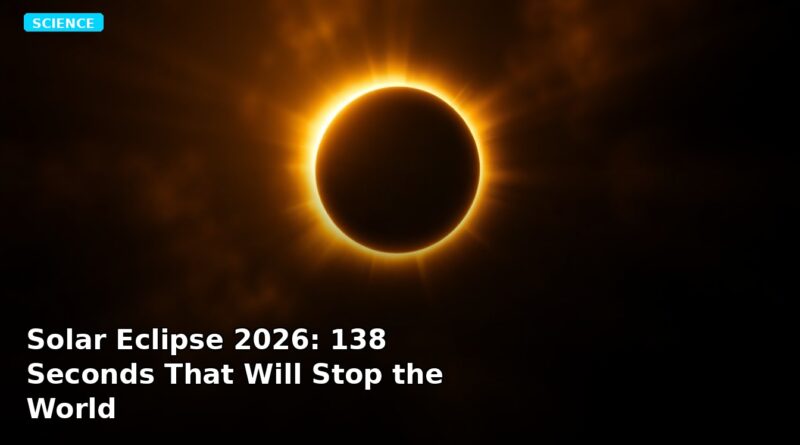
Solar Eclipse 2026: 138 Seconds That Will Stop the World
Solar Eclipse 2026: 138 Seconds That Will Stop the World
The Sun disappears. In the middle of the day, stars appear in the sky. Birds go silent. Temperatures drop. And then, 2 minutes and 18 seconds later, it’s over — as if nothing happened.
That’s what’s coming on August 12, 2026. A total solar eclipse with a totality window of exactly 138 seconds, carving a path 294 kilometers wide across the Earth’s surface. And the science behind why that narrow strip of shadow exists — and why it lasts only that long — is far stranger than most people realize.
What a Total Solar Eclipse Actually Is (Not What You Think)
Most people picture a solar eclipse as the Moon simply “covering” the Sun. That’s accurate enough — but it misses the extraordinary coincidence that makes it possible at all.
The Sun is roughly 400 times wider than the Moon. It also happens to be roughly 400 times farther away. That near-perfect ratio means both objects appear almost identical in size when viewed from Earth’s surface. No other planet in the solar system has this relationship between its star and its moon. On Jupiter or Mars, solar eclipses look nothing like this — they’re partial shadows at best.
When the geometry aligns perfectly, the Moon’s shadow — called the umbra — falls on Earth as a narrow cone. That cone is what creates the totality band. Step outside it, even by a few kilometers, and you see only a partial eclipse. Step inside it, and daylight vanishes entirely.
For the August 12, 2026 eclipse, that cone touches Earth in a band 294 km wide at its maximum. It sounds large on paper. On a planet with a circumference of roughly 40,000 km, it’s a razor-thin line.
The 138-Second Window: Why Totality Is So Short
Here’s the number that puts everything in perspective: 138 seconds. That’s the maximum duration of totality for the August 12, 2026 eclipse — 2 minutes and 18 seconds at the point of greatest eclipse, which occurs at 17:47:06 UTC, at coordinates 65°12′N, 25°12′W.
Two minutes. That’s it. And yet, for the people standing in that band, it will be one of the most disorienting experiences of their lives.
Why so brief? The Moon’s shadow moves across Earth’s surface at roughly 1,700 km/h. Even at 294 km wide, a shadow traveling that fast passes any fixed point in minutes — sometimes less. The exact duration at any given location depends on where you stand within the totality band. Stand at the center line, and you get the full 138 seconds. Stand near the edge, and totality might last only 30 or 40 seconds before the Sun reappears.
Historically, the longest total solar eclipses can last up to about 7 minutes — but those are rare alignments when the Moon is near its closest point to Earth (making its apparent size larger) and the Sun is near its farthest (making its apparent size smaller). The August 2026 eclipse, with a magnitude of 1.0386, sits just above the threshold needed for totality — meaning the Moon barely covers the Sun’s disk. That’s why 138 seconds is the ceiling, not the floor.
Saros 126: The 18-Year Clockwork Behind Every Eclipse
The August 12, 2026 total solar eclipse doesn’t exist in isolation. It belongs to Saros series 126 — and it’s the 48th eclipse out of 72 in that series.
The Saros cycle is one of astronomy’s most elegant patterns. Every 18 years, 11 days, and 8 hours, the Sun, Moon, and Earth return to almost exactly the same geometric alignment. That means every eclipse in a Saros series is a near-copy of the one that came 18 years before it — same approximate duration, same approximate path, slightly shifted in longitude.
Ancient Babylonian astronomers identified this cycle without telescopes, without satellites, and without calculus. They tracked eclipses over centuries and noticed the 18-year rhythm. That knowledge let them predict eclipses that hadn’t happened yet — a capability that, in the ancient world, carried enormous political and religious weight.
Saros 126 has been running for centuries. The August 2026 eclipse is the 48th entry in that series, meaning this particular geometric family of eclipses has been repeating — reliably, predictably — long before any living person was born. There are 72 total eclipses in the series. The 48th is the one coming this August.
Where to See It (And Why India Won’t)
The greatest eclipse on August 12, 2026 occurs at coordinates 65°12′N, 25°12′W — a point in the North Atlantic, near Iceland. The totality path tracks across the high northern latitudes, meaning the prime viewing locations are in the Arctic and northern European regions.
For viewers in India, there’s a straightforward reality: neither the February 17, 2026 annular eclipse nor the August 12 total eclipse will be visible from the subcontinent. The February eclipse — a “Ring of Fire” annular event — is visible in the Southern Hemisphere, including Antarctica. The August eclipse tracks far to the north.
That said, 2026 is a double-eclipse year worth knowing about. Two solar eclipses in a single calendar year is not unusual — it happens because the geometry of Earth’s orbit around the Sun and the Moon’s orbit around Earth produces eclipse seasons roughly every six months. What makes 2026 notable is the contrast: one annular eclipse in the deep south, one total eclipse in the far north, within the same calendar year.
For Indian skywatchers, the significance of August 12, 2026 is less about direct observation and more about what it demonstrates — that the universe runs on clockwork precise enough to predict to the second, centuries in advance.
What Happens to Earth During Those 138 Seconds
The shadow arrives faster than most people expect. One moment the sky is bright; within seconds, it dims to a deep twilight. Planets and bright stars become visible in the middle of the day. The temperature drops — sometimes by several degrees Celsius within minutes. Animals behave as if night has fallen: birds stop singing, insects begin their evening calls, and some flowers close their petals.
At the moment of totality, the Sun’s corona — its outer atmosphere — becomes visible to the naked eye. Under normal conditions, the corona is completely invisible, drowned out by the Sun’s surface brightness. Totality is the only time humans can see it without specialized equipment. It appears as a white, wispy halo, asymmetric and alive-looking, extending several solar diameters into space.
This is why scientists — and in particular, researchers studying solar physics — treat total eclipses as irreplaceable observational events. For 138 seconds, the Moon does something no human-made instrument can fully replicate: it blocks the Sun’s disk with perfect precision, revealing the corona in its natural state.
Then the diamond ring effect flashes at the edge of the Moon — a single bead of sunlight breaking through a lunar valley — and it’s over. The shadow races on. The birds start singing again.
Final Thought
Two minutes and 18 seconds sounds trivial. But the August 12, 2026 total solar eclipse — the 48th eclipse in Saros series 126, arriving at 17:47:06 UTC — is the product of a geometric coincidence so precise that ancient civilizations built entire calendars around predicting it. The Moon is 400 times smaller than the Sun and 400 times closer. That ratio is what makes totality possible at all. Change either number slightly, and the corona stays hidden forever. The 294-km totality band and the 138-second window aren’t limitations — they’re the signature of a solar system that happens, against all odds, to be shaped exactly right for this.
Frequently Asked Questions
When is the next total solar eclipse in 2026?
The next total solar eclipse occurs on August 12, 2026, with the point of greatest eclipse happening at 17:47:06 UTC. It will carve a totality path 294 kilometers wide across Earth’s surface.
How long will the 2026 solar eclipse totality last?
The maximum duration of totality for the August 12, 2026 solar eclipse is 138 seconds, or 2 minutes and 18 seconds, at the point of greatest eclipse.
Why does a total solar eclipse happen?
A total solar eclipse occurs because the Sun is roughly 400 times wider than the Moon but also 400 times farther away, making them appear nearly identical in size from Earth, allowing the Moon to completely block the Sun.
Recommended Reading
Explore these hand-picked resources to dive deeper into this topic:
- Astrophysics for People in a Hurry by Neil deGrasse Tyson
- The Universe in a Nutshell by Stephen Hawking
- Solar Eclipse Glasses (ISO 12312-2 certified)
As an Amazon Associate, we earn from qualifying purchases. This helps support Fact Storm Hub at no extra cost to you.
Sources
- https://timesofindia.indiatimes.com/astrology/planets-transits/solar-eclipse-in-2026-check-date-time-and-visibility-in-india/articleshow/127994035.cms
- https://www.timeanddate.com/eclipse/2026
- https://en.wikipedia.org/wiki/Solar_eclipse_of_August_12,_2026
- https://www.thehindu.com/sci-tech/science/solar-eclipse-2026-when-to-watch-visibility-in-india-timings-how-to-watch/article70618610.ece
- https://www.drikpanchang.com/eclipse/eclipse-date-time.html
Watch the Video
🤖 AI Content Disclosure
This article was created using AI-assisted research and writing tools, then reviewed for quality and accuracy. Facts are sourced from publicly available web research, but readers should verify critical information from primary sources.
Published for educational and entertainment purposes. Last reviewed: May 2026