
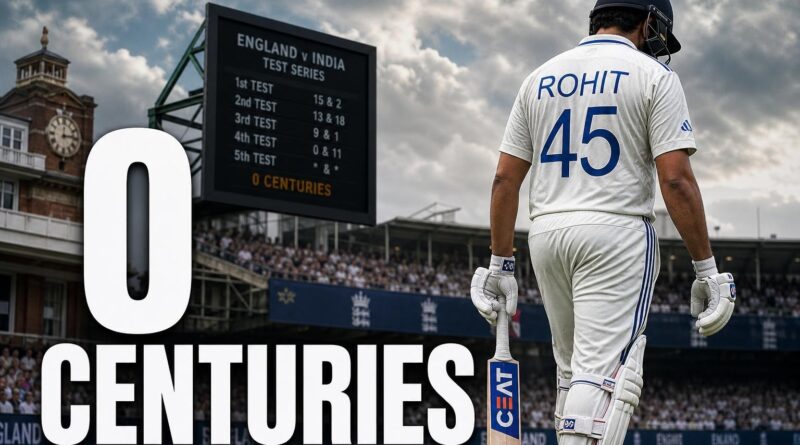
Rohit Sharma’s England Record Will Shock You
Rohit Sharma’s England Record Will Shock You
He didn’t have to arrive early. Most cricketers at 39, carrying the weight of a career that spans nearly two decades, would let the preparation come to them. Instead, Rohit Gurunath Sharma landed in London ahead of schedule, found a training ground, and got to work. That detail — quiet, deliberate, easy to miss — tells you more about why England should be worried than any headline statistic ever could.
This is a batter who has been selected for 159 T20 Internationals. Not 59. Not 99. One hundred and fifty-nine — more than any other Indian cricketer in history. He led India to two global finals in a single calendar year. He is, by almost every measure of longevity and trust, the most consistently selected Indian cricketer of his generation. And he is currently in London, preparing for a three-ODI series against England with the kind of focused intent that should make the hosts deeply uncomfortable.
The Boy From Nagpur Who Waited Longer Than Anyone Expected
Rohit Sharma — born 30 April 1987 in Nagpur, Maharashtra — made his ODI debut on 23 June 2007 against Ireland. He was 20 years old, and Indian cricket was already whispering about what he might become.
What followed was years of promise without proof. The talent was undeniable: a right-handed top-order batter with timing so clean it looked effortless, stroke-play that made coaches stop mid-sentence. But consistency refused to arrive. He’d produce a stunning innings, then go quiet for a month. The cricketing world has a word for players like that — “potential” — and it’s a compliment that slowly curdles into a question mark.
His Test debut didn’t come until 6 November 2013 against West Indies. That’s six years after his ODI debut. Six years of selectors watching, waiting, and remaining unsure where Rohit Sharma fit in the longest format of the game. That gap is not a footnote. It is the entire first chapter of his story.
The Positional Change That Unlocked Everything
The turning point wasn’t a century or a series win. It was a decision — move Rohit to open the batting in ODIs.
As a middle-order batter, the role demanded he arrive under pressure and score immediately. Opening gave him something different: time. He could read the conditions, settle into his rhythm, and then — once he was set — accelerate in a way that few batters in world cricket can match. The effortless timing that had always been there suddenly had a format and a position that suited it perfectly.
What followed was a career that redefined what longevity looks like in Indian cricket. Rohit became the most-played Indian cricketer in T20 Internationals, accumulating 159 appearances. That number is not a hot streak captured in a spreadsheet. It is the result of selectors, year after year, across different regimes and different tournaments, arriving at the same conclusion: Rohit Sharma belongs in this squad.
The Captain Who Reached Two Finals in One Year
Rohit Sharma didn’t just endure in Indian cricket. He eventually led it — across all three formats, ODIs, Tests, and T20Is simultaneously.
And captaincy, for Rohit, was not ceremonial. In 2023, he led India to the final of the ICC Men’s Cricket World Cup. In the same calendar year, he led India to the final of the World Test Championship. Two global finals. Two different formats. One year.
Most captains spend entire careers chasing a single final. Rohit reached both, steering a team that carries the particular weight of representing 1.4 billion people who treat cricket as something closer to religion than sport. The results of those finals are part of the historical record. The journey to get there — the squad management, the tactical decisions, the pressure absorbed so his players didn’t have to — revealed a version of Rohit Sharma that the 20-year-old debutant from 2007 could not have predicted becoming.
What England Means Right Now
His last Test match was on 26 December 2024 against Australia. Since then, the conversation around Rohit has shifted. He is no longer the incumbent captain across all formats. There are genuine questions about what the next chapter looks like, and whether there is a next chapter at all.
He answered those questions by getting on a plane to London before he needed to.
The early arrival is not a small thing. It signals deliberate preparation — a batter who wants to feel English conditions under his feet before the series begins, who wants the practice sessions, the adjustment period, the time to recalibrate. That is not the behaviour of a cricketer coasting on reputation. That is the behaviour of someone who intends to compete.
Why England Should Take This Seriously in 2026
The three-ODI series against England is not a farewell tour dressed up as a selection. The documented career arc — 159 T20I appearances, two global finals, a Test career that stretched from 2013 to late 2024 — belongs to a cricketer who has repeatedly performed when the stakes were highest.
England, as hosts, will carry the advantage of familiar conditions. But they are facing a batter whose entire career story is built on outlasting expectations: six years to a Test debut, a positional change that rewrote his trajectory, a captaincy that produced two global finals in twelve months. Every time the narrative suggested Rohit Sharma was finished or fading, the evidence pointed the other way.
He is in London now. He arrived early. He is preparing with intent. For a three-match ODI series that carries real stakes for both sides, that combination — documented longevity, leadership pedigree, and deliberate preparation — is precisely what should keep England’s camp honest.
Final Thought
The easiest version of this story lists the records: 159 T20I appearances, two World finals in 2023, a Test career that ended as recently as December 2024. But records are just the receipts. The actual story is about a cricketer from Nagpur who spent six years waiting for a Test debut, found his best form only after a positional change, and then spent the next decade being the most-selected Indian player in the shortest format of the game.
He’s in London right now. He arrived early. He’s preparing for three ODIs against England with the kind of focused intent that his career — every patient, hard-won chapter of it — has always produced when it mattered most.
England have been warned. Not by a statistic. By the man himself, and by everything he has already done.
Frequently Asked Questions
How many T20 Internationals has Rohit Sharma played?
Rohit Sharma has been selected for 159 T20 Internationals, more than any other Indian cricketer in history, making him the most consistently selected Indian cricketer of his generation.
When did Rohit Sharma make his ODI debut?
Rohit Sharma made his ODI debut on 23 June 2007 against Ireland at the age of 20, though his Test debut didn’t come until 6 November 2013 against West Indies.
Where was Rohit Sharma born and how old is he?
Rohit Gurunath Sharma was born on 30 April 1987 in Nagpur, Maharashtra, making him 39 years old and one of the most experienced active cricketers in international cricket.
Recommended Reading
Explore these hand-picked resources to dive deeper into this topic:
- Rohit Sharma: The Hitman’s Journey by Vijay Lokapally
- The Test: My Life with India’s Greatest Cricket Team by Rajdeep Sardesai
- Cricket Academy Online Course (interactive coaching platform)
As an Amazon Associate, we earn from qualifying purchases. This helps support Fact Storm Hub at no extra cost to you.
Sources
- https://en.wikipedia.org/wiki/Rohit_Sharma
- https://www.cricinfo.com/cricketers/rohit-sharma-34102
- https://www.cricbuzz.com/profiles/576/rohit-sharma
- https://www.youtube.com/user/rozsharma
- https://www.indiatoday.in/author/rohit-sharma-0
🤖 AI Content Disclosure
This article was created using AI-assisted research and writing tools, then reviewed for quality and accuracy. Facts are sourced from publicly available web research, but readers should verify critical information from primary sources.
Published for educational and entertainment purposes. Last reviewed: July 2026