
How Smartphone Cameras Evolved to 200MP
How Smartphone Cameras Evolved to 200MP
In August 2026, Redmi launched two phones in China. One of them — the K100 Pro — carries a 200MP camera, an 8,580mAh battery, and a price tag sitting around CNY 4,000 (roughly $592). That last number is the one that should stop you cold. Because 200 megapixels and a battery that would have powered a mid-range laptop just a decade ago used to be the exclusive territory of phones costing twice that. The wall between flagship and mid-range isn’t crumbling slowly. It’s already down. But to understand why that matters, you have to go back to the beginning — to a camera nobody wanted, on a phone nobody asked for.
The Accident That Started It All
Nobody set out to build a camera phone. The camera was an afterthought — almost an embarrassment.
The earliest mobile cameras were low-resolution sensors borrowed from fax machine technology. Engineers weren’t thinking about photography. They were thinking about sending small, compressed images over slow data networks. The first commercial camera phones that reached consumers produced images so grainy and washed-out that professional photographers publicly mocked them. The consensus in the industry was simple: if you want a photo, carry a camera.
But consumers didn’t listen. They didn’t care about image quality the way professionals defined it. What they cared about was immediacy — the ability to point, shoot, and share without carrying a second device. That behavioural insight, not the technology, is what made the camera phone unstoppable. Within a few years of the first commercial launch, standalone digital camera sales began a decline they never recovered from.
The camera hadn’t replaced the phone. The phone had swallowed the camera whole.
The Megapixel Wars Begin
Once manufacturers understood that consumers wanted cameras on their phones, the race began — and it got competitive fast.
For years, megapixel count became the single most marketed number on any smartphone box. More megapixels meant a better camera, or so the advertising claimed. In reality, megapixel count is only one part of the picture — sensor size, lens quality, and software processing matter just as much, sometimes more. But the number was easy to understand and easy to compare on a shelf, so it won.
Then the arms race crossed a threshold that once seemed purely theoretical: 200 megapixels on a consumer device. The Redmi Note 15 Pro+ 5G, launched in India at ₹37,999, ships with a 200MP AI camera powered by a Snapdragon 7s Gen 4 chip with AI camera processing built in. Meanwhile, the Redmi Note 15 Pro 5G brings its own 200MP OIS camera to a slightly different configuration — Dimensity 7400-Ultra, a 17.3cm CrystalRes AMOLED display, and an IP66/68/69/69K water resistance rating that no one expected at this price tier.
These aren’t flagship-tier prices. These are phones that a college student in Mumbai or Chennai can actually buy. That shift — 200MP moving from premium flagship to mid-range — is the real story happening right now in 2026. And it starts with understanding what 200MP actually does.
What 200MP Actually Means (And What It Doesn’t)
Here’s where most people get confused.
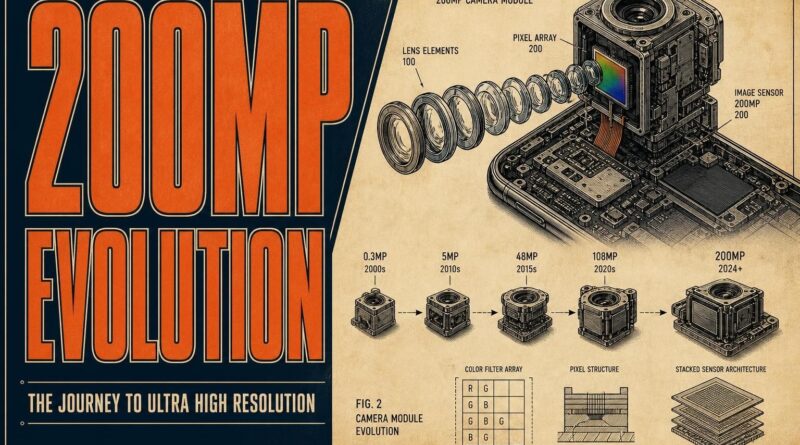
A 200MP sensor doesn’t mean every photo you take is 200 megapixels in size. That would produce a single image file large enough to crash most phones. Instead, modern 200MP cameras use a technique called pixel binning — they combine groups of smaller pixels into one larger, brighter “super pixel” for everyday shots. The result is a sharper, better-lit image in normal conditions, with the option to shoot in full 200MP resolution when you genuinely need extreme detail.
Think of it like this: you have 200 workers available, but for most jobs, you send them in teams of four. The work gets done faster and better. Only for the most demanding jobs do you deploy all 200 at once.
The Redmi Note 15 Pro 5G pairs its 200MP sensor with OIS — optical image stabilisation — which physically moves the lens to compensate for hand movement. That matters more than most people realise. A high-resolution sensor without stabilisation is like a Formula 1 car on a dirt road. The resolution is there. The conditions to use it aren’t. The Redmi K100 Pro takes this further still, offering a triple rear camera system across five focal lengths — including a telephoto lens capable of 10cm macro photography. Resolution and versatility, in the same pocket.
The Battery Problem Nobody Solved — Until Now
For years, the camera phone had one enemy that no megapixel count could fix: the battery.
Here’s the tension engineers lived with for over a decade. Processing high-resolution images requires serious computational power. Running a high-refresh AMOLED display drains power at a rate older battery chemistry simply couldn’t sustain. The faster and brighter phones became, the faster they died — and traditional lithium-ion batteries had hit a hard ceiling. There was only so much energy you could pack into a given physical space before the battery became too large, too heavy, or dangerously hot.
That ceiling is what silicon-carbon (Si/C) anode technology finally broke. Silicon stores significantly more charge than the graphite used in conventional lithium-ion cells — the trade-off had always been that silicon expands and contracts during charge cycles, degrading quickly. Silicon-carbon composites solved that structural problem, enabling far greater energy density without sacrificing longevity.
The results are now shipping in real products. The Redmi Note 15 Pro 5G carries a 6,580mAh Si/C battery with 45W fast charging. The Redmi K100 Pro, launched August 11, 2026, goes further: 8,580mAh, with 100W wired charging and 50W wireless charging. It also supports 27W wired reverse charging and 22.5W wireless reverse charging — meaning the phone can charge other devices. The phone has become the power bank.
The Display That Changed How We See Photos
A 200MP camera is only as useful as the screen you’re viewing it on — and for most of smartphone history, that screen was the weak link.
Capture technology raced ahead while display technology shuffled to keep up. You could shoot extraordinary detail and then view it on a panel that rendered half of it inaccurately, at a refresh rate that made motion look like a slideshow. The gap between what the camera saw and what the screen showed was the dirty secret of the megapixel era.
That gap is closing. The Redmi K100 Pro ships with a 6.59-inch display running at 185Hz — more than three times the refresh rate of a standard 60Hz television. At that speed, scrolling feels frictionless, video looks continuous rather than sampled, and the full resolution of a 200MP image can actually be explored without the display becoming the bottleneck. The Redmi Note 15 Pro 5G offers its own 1.5K CrystalRes AMOLED panel, designed to render the fine detail its 200MP sensor captures rather than discard it.
This is the part of the story that rarely gets told. The camera phone revolution isn’t just about how we capture the world. It’s about how we see it — and at CNY 4,000 or ₹37,999, that experience is no longer something you save up for. It’s something you buy on a Tuesday afternoon and carry in your jeans.
That’s what changed. Not just the megapixels. The access.
Frequently Asked Questions
When did camera phones first become popular?
Camera phones took off in the early 2000s when consumers embraced the ability to instantly capture and share photos without carrying a separate device, causing standalone digital camera sales to begin a decline they never recovered from.
What phone has a 200MP camera in 2026?
The Redmi K100 Pro, launched in China in August 2026, features a 200MP camera and an 8,580mAh battery at a price of approximately CNY 4,000, or roughly $592.
Why did camera phones replace digital cameras?
Consumers prioritized immediacy over image quality, preferring to point, shoot, and share from a single device rather than carrying a separate camera, making the camera phone’s rise unstoppable despite early criticism over poor image quality.
Recommended Reading
Explore these hand-picked resources to dive deeper into this topic:
- The Innovators by Walter Isaacson
- A Brief History of Time by Stephen Hawking
- DJI Mini 3 Pro (compact drone camera)
As an Amazon Associate, we earn from qualifying purchases. This helps support Fact Storm Hub at no extra cost to you.
Sources
- https://www.amazon.in/redmi-200-mp-camera-mobile-5g/s?k=redmi+200+mp+camera+mobile+5g
- https://www.youtube.com/watch?v=V6EP_EnBdlc
- https://www.notebookcheck.net/High-end-Xiaomi-phone-confirmed-with-200MP-camera-and-large-battery.1360508.0.html
- https://www.mi.com/global/product/xiaomi-12t-pro/
- https://indianexpress.com/article/technology/mobile-tabs/redmi-note-15-pro-series-specs-features-availability-price-india-10500998/
🤖 AI Content Disclosure
This article was created using AI-assisted research and writing tools, then reviewed for quality and accuracy. Facts are sourced from publicly available web research, but readers should verify critical information from primary sources.
Published for educational and entertainment purposes. Last reviewed: August 2026