
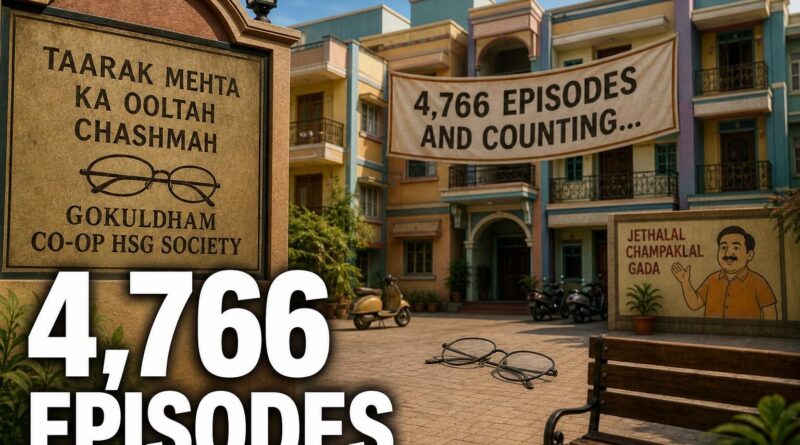
Taarak Mehta’s 4,766 Episodes: The Untold Truth
Taarak Mehta’s 4,766 Episodes: The Untold Truth
This week, fans across India panicked. Rumours spread that Dilip Joshi — the man behind Jethalal, the lovable, bumbling heart of Taarak Mehta Ka Ooltah Chashmah — was leaving the show. The makers quickly denied it. Dilip Joshi is staying.
But the rumour itself tells you something important: after 18 years and 4,766 episodes, this show still matters enough that a single casting whisper breaks the internet. That doesn’t happen by accident. That’s a story worth understanding.
The Column That Started Everything
Before there was a show, there was a writer.
Tarak Janubhai Mehta was born on 26 December 1929. For decades, he wrote a weekly humour column called Duniya Ne Undha Chashmah — which roughly translates to “The World Through an Upside-Down Lens.” The column ran for years in Gujarati publications and built a quiet, loyal following. Mehta wasn’t writing for television. He was writing about the small, funny, deeply human moments of everyday Indian life — neighbourhood gossip, family arguments, the gap between how people present themselves and who they actually are.
What made the column last wasn’t jokes. It was observation. Mehta had a gift for noticing the absurdity inside ordinary situations. A misunderstanding between neighbours. A husband trying to hide something from his wife. The way people from different parts of India talk past each other and then somehow end up friends.
Tarak Mehta died on 1 March 2017. He never saw his column become one of the longest-running sitcoms in Indian television history. But the world he built on the page? It’s still airing every single week.
July 28, 2008 — The Night Gokuldham Opened Its Gates
Producer Asit Kumarr Modi and Neela Asit Modi of Neela Film Productions took a risk when they adapted Mehta’s column for Sony SAB. Adapting a print humour column for daily television is genuinely hard. Columns work in 800-word bursts. Daily television needs conflict, character arcs, and stories that keep viewers coming back tomorrow.
Their solution was geography. Instead of following one family, they built a world: Gokuldham Co-operative Housing Society in Goregaon, Mumbai. A single apartment complex with residents from different states, different religions, different economic backgrounds — all forced to share walls, staircases, and each other’s problems.
On July 28, 2008, the first episode aired.
The premise was simple. The execution was precise. Jethalal Champaklal Gada — a Gujarati shop owner with big ambitions and bigger problems — became the anchor. Around him, the show built a cast that felt less like characters and more like people you might actually know: the Iyers from Tamil Nadu, the Bhide family, the Habibs, old Champak Chacha. Different languages, different festivals, different food — all under one roof.
That’s not just a sitcom setup. That’s a quiet argument about what India actually looks like.
Why 4,766 Episodes Is a Number That Should Stop You Cold
Most people hear “long-running TV show” and nod politely. But 4,766 episodes — the count as of July 18, 2026 — deserves a moment of real attention.
Consider what that number means in production terms. A new episode, almost every single weekday, for 18 consecutive years. That means writers generating storylines continuously. Actors showing up on set year after year. A crew maintaining consistent production quality across nearly two decades. No major hiatus. No cancellation scare that stuck.
For comparison, many Indian fiction shows that become hits run for a few hundred episodes before fatigue sets in — either audiences move on, or the production runs out of story. TMKOC didn’t just survive that curve. It lapped it.
And the audience didn’t drift away quietly. According to Ormax Rankings, the show recently ranked as the second most-watched OTT show in India — beating major streaming releases and holding its ground even during IPL 2026 and the competitive Dhurandhar release window. A show that first aired in 2008 is outperforming content built specifically for the streaming generation. That’s not nostalgia. That’s something structurally different about what this show does.
The One Thing That Kept It Alive
Shailesh Lodha narrated the show from 2008 all the way through 2022 — 14 years of setting tone and context for every episode. When he stepped away, Sachin Shroff took over from 2022 to the present. The narration shift was noticed by fans, debated online, and then absorbed. The show continued.
That kind of resilience — absorbing cast changes, narrator changes, cultural shifts — points to something the makers got fundamentally right from the beginning. They didn’t build the show around any single actor or any single relationship. They built it around a place.
Gokuldham is the main character. The residents come and go. The society stays.
This is actually a rare structural choice in Indian television, where shows often live or die on the chemistry of one central pair. TMKOC distributed its emotional weight across an ensemble, which meant no single departure could collapse the whole structure. When rumours spread this week that Dilip Joshi might leave, the makers denied it — but the fact that the show has survived multiple significant changes over 18 years suggests it was built to last beyond any one person.
Final Thought
The panic over Dilip Joshi’s rumoured exit is understandable — Jethalal is the show’s most visible face. But here’s the story nobody actually tells: Taarak Mehta Ka Ooltah Chashmah was never really about any single actor. It was about a humour column written by a man born in 1929, adapted into a sitcom set in a Mumbai housing society, that has now crossed 4,766 episodes and — according to Ormax Rankings — is still beating streaming-era competition in 2026. Tarak Mehta the writer built a lens for looking at Indian life. Asit Kumarr Modi turned that lens into a world sturdy enough to outlast cast changes, narrator swaps, and the entire rise of OTT. Jethalal may be the face people panic about losing. Gokuldham is the thing they’d actually miss.
Frequently Asked Questions
How many episodes of Taarak Mehta Ka Ooltah Chashmah have aired?
Taarak Mehta Ka Ooltah Chashmah has aired 4,766 episodes over 18 years, making it one of the longest-running sitcoms in Indian television history.
Who was Tarak Mehta and what did he write?
Tarak Mehta was a writer born on 26 December 1929 who authored a weekly Gujarati humour column called Duniya Ne Undha Chashmah, which inspired the popular TV show. He passed away on 1 March 2017.
When did Taarak Mehta Ka Ooltah Chashmah first air on TV?
Taarak Mehta Ka Ooltah Chashmah premiered on July 28, 2008 on Sony SAB, produced by Asit Kumarr Modi and Neela Asit Modi of Neela Film Productions.
Recommended Reading
Explore these hand-picked resources to dive deeper into this topic:
- The Indianness of Indian Cinema by Amartya Sen
- How I Became Successful by Taarak Mehta
- Sony A6400 Mirrorless Camera (content creation tool)
As an Amazon Associate, we earn from qualifying purchases. This helps support Fact Storm Hub at no extra cost to you.
Sources
- https://en.wikipedia.org/wiki/Taarak_Mehta_Ka_Ooltah_Chashmah
- https://www.youtube.com/channel/UCnSFZ-olBoLGLRUS_3RI2Aw
- https://www.youtube.com/channel/UC54_ux4BnaJwkVFn5M391XQ
- https://www.youtube.com/watch?v=cRaDLf0cRqs
- https://m.imdb.com/title/tt1708446/
🤖 AI Content Disclosure
This article was created using AI-assisted research and writing tools, then reviewed for quality and accuracy. Facts are sourced from publicly available web research, but readers should verify critical information from primary sources.
Published for educational and entertainment purposes. Last reviewed: July 2026