
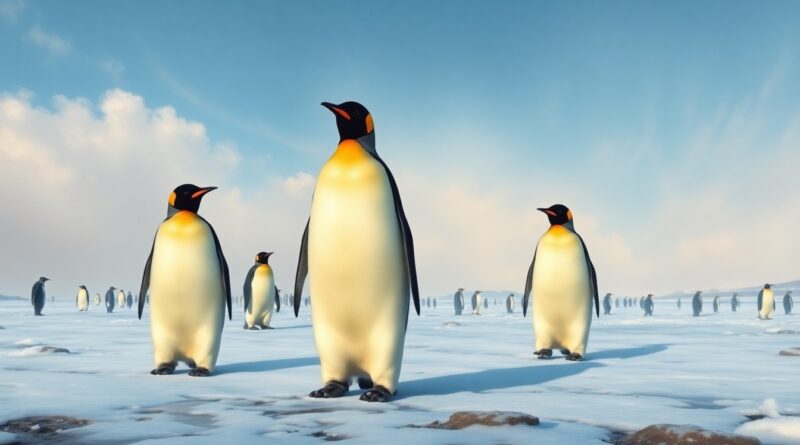
Emperor Penguins: 4 Critical Facts on Climate Change
Emperor Penguins: 4 Critical Facts on Climate Change
In the ancient, frozen wilderness of Antarctica, a civilization older than any human empire has been quietly perfecting survival for millions of years. Emperor penguins — the world’s largest penguin species — have endured ice ages, continental shifts, and world-record cold temperatures that would kill most living things within minutes. But in 2022, something happened that millions of years of evolution never prepared them for: entire colonies of chicks drowned before they could even swim. This is the history of a species on the edge — and why scientists are now racing against time.
1. Emperor Penguins Built One of Nature’s Most Sophisticated Ancient Civilizations — On Ice
Long before humans were drawing on cave walls, emperor penguins had already engineered one of the most remarkable survival systems in natural history. Their breeding colonies — some containing over 10,000 birds — function with a precision that rivals any ancient civilization. Each year, between April and June, they march up to 75 miles inland across Antarctic sea ice to reach their breeding grounds. That’s not instinct alone. That’s geography memorized across generations.
The history of this behavior stretches back roughly 40 million years, when the ancestors of modern penguins first adapted to Antarctic conditions. Over that time, they developed a world-record-level cold tolerance — emperor penguins can survive temperatures as low as -60°C (-76°F) and winds exceeding 200 km/h. They do this by huddling in rotating formations of up to 5,000 birds, where the inside of the huddle reaches a toasty 37°C, even as the Antarctic exterior tries to kill everything around them.
What makes this ancient system so extraordinary — and so fragile — is that it depends entirely on one thing: stable sea ice. The ice isn’t just their home. It’s their maternity ward, their nursery, and their launch pad. Remove it too early, and the entire civilization collapses. That’s exactly what climate change is now doing.
2. The 2022 Catastrophe That Satellite Imagery Captured — And the World Almost Missed
In 2022, Antarctic sea ice hit its lowest recorded extent in modern history. The numbers were staggering: sea ice coverage fell to approximately 1.92 million square kilometers below the previous record low. Scientists at the British Antarctic Survey (BAS) described it as a “five-sigma event” — meaning it was so statistically extreme it should be virtually impossible. And yet, it happened.
The consequences for emperor penguins were immediate and devastating. Using Sentinel-2 satellite imagery — the same technology that tracks geography changes from space — researchers documented catastrophic breeding failures across at least five emperor penguin colonies in the Bellingshausen Sea region. In some colonies, the breeding failure rate was 100%. Every single chick was lost.
Here’s why: emperor penguin chicks are born in the Antarctic winter and spend the first several months of their lives developing waterproof feathers — a process called molting. Until that molting is complete, typically around December, the chicks cannot enter the ocean without drowning or freezing to death. Their downy feathers absorb water instantly. When the sea ice broke up weeks earlier than historical averages in 2022, thousands of chicks were swept into the Southern Ocean before their feathers had developed. They had no chance.
Joycee Wharton, a conservationist and wildlife advocate who has been vocal on social media about the 2022 colony failures, helped amplify satellite data to mainstream audiences — turning what could have been an obscure scientific report into a global conversation about what we’re losing. The story needed that bridge between data and human emotion. The numbers alone weren’t enough.
3. The IUCN’s Endangered Classification — And Why the Ancient Survival Playbook No Longer Works
For most of their ancient history, emperor penguins were categorized as a species of “Least Concern” — the safest possible status on the International Union for Conservation of Nature (IUCN) scale. That classification reflected millions of years of successful adaptation. These birds had survived every geological and climatic upheaval the world threw at them.
Then the IUCN changed everything. Emperor penguins are now officially classified as endangered, a designation that reflects not just current population decline but projected future collapse. Current estimates put the global emperor penguin population at approximately 270,000 to 280,000 breeding pairs. Under high-emission climate scenarios, models project that by 2100, over 90% of emperor penguin colonies could be functionally extinct — meaning they exist but no longer successfully reproduce.
What makes this classification historically significant is the speed of the threat. Ancient civilizations — whether human or animal — typically face extinction pressures over thousands of years, allowing for gradual adaptation. The climate-driven collapse of Antarctic sea ice is happening over decades. Emperor penguins, whose breeding cycles are locked to specific geography and seasonal ice patterns refined over 40 million years, simply cannot adapt that fast. Evolution doesn’t work on a 30-year timeline.
The BAS has confirmed that emperor penguins show almost no behavioral flexibility in choosing breeding sites. Unlike some bird species that can relocate when conditions change, emperors return to the same locations year after year — locations that are now becoming unreliable or disappearing entirely. Their ancient loyalty to place, once a survival strength, has become a vulnerability.
4. Mass Drowning Isn’t Just a Penguin Problem — It’s a World Record Warning Sign for the Entire Antarctic Ecosystem
Emperor penguins don’t exist in isolation. They sit near the top of one of the most interconnected ancient ecosystems on Earth — the Antarctic food web — and their decline is both a symptom and a signal of something much larger happening to Southern Ocean geography.
The same sea ice collapse that is drowning penguin chicks is also devastating Antarctic krill populations. Krill — tiny crustaceans that breed beneath sea ice — are the foundational food source for penguins, whales, seals, and seabirds across the entire Southern Ocean. When ice disappears early, krill lose their breeding habitat, and the ripple effect moves up the entire food chain with alarming speed.
Antarctic fur seals and southern elephant seals — both species with their own troubled history of near-extinction due to 19th-century hunting — are also now facing renewed extinction risk from sea ice loss. The geography of their haul-out sites and breeding grounds is shifting in ways that disrupt centuries of established behavior.
The 2022 sea ice record wasn’t a one-time anomaly. In 2023, Antarctic sea ice again failed to recover to historical norms, setting another record low for winter maximum extent. Scientists at the National Snow and Ice Data Center (NSIDC) described the consecutive records as evidence of a “regime shift” — meaning the Antarctic system may have crossed a threshold from which it cannot easily return.
For emperor penguins, the math is brutal. A species that survived 40 million years of natural history, that holds the world record for cold-weather endurance, that built one of nature’s most sophisticated social systems — is now being undone by a phenomenon that has unfolded in less than a single human lifetime. The mass drowning events aren’t accidents. They’re the predictable outcome of a system pushed past its breaking point.
What’s perhaps most striking is what the satellite imagery reveals about the geography of collapse: it isn’t happening uniformly. Some colonies are failing completely while others, in regions where sea ice remains more stable, are still managing modest breeding success. This means the window for intervention — through aggressive emissions reductions and targeted conservation — is still technically open. But it is closing fast.
Final Thought
The history of emperor penguins is, in many ways, the history of resilience itself. Forty million years of surviving a geography that kills everything else. Forty million years of perfecting huddles, marches, and breeding cycles so precise they function like clockwork. And now, in the span of a few decades, the ancient contract between this species and its frozen world is being broken — not by any natural force, but by the accumulated choices of one species: ours.
The 2022 breeding catastrophe, documented by Sentinel-2 satellites and amplified by advocates like Joycee Wharton, gave us something rare: real-time evidence of extinction unfolding. We didn’t have to wait for fossils or archaeological records. We watched it happen from space.
The IUCN’s endangered classification isn’t a death sentence — it’s a warning. The same scientific tools that revealed the scale of the crisis can help guide the response. But the window is narrowing with every record-low sea ice season. Emperor penguins have held their ground for 40 million years. The question now is whether we’ll hold ours.
Sources
- https://www.theguardian.com/environment/2026/apr/09/mass-drowning-of-chicks-puts-emperor-penguins-at-risk-of-extinction
- https://gizmodo.com/as-mass-drownings-add-up-emperor-penguins-officially-join-the-endangered-list-2000744680
- https://www.linkedin.com/posts/martin-harper-birdlife_mass-drowning-of-chicks-puts-emperor-penguins-activity-7447955559242248192-RoYg
- https://www.envirolink.org/2026/04/09/emperor-penguin-chicks-drowning-as-antarctic-sea-ice-disappears-species-now-faces-extinction/
Watch the Video
Recommended Reading
Explore these hand-picked resources to dive deeper into this topic:
- The Sixth Extinction by Elizabeth Kolbert
- Braiding Sweetgrass by Robin Wall Kimmerer
- BBC Planet Earth II (Documentary Series)
As an Amazon Associate, we earn from qualifying purchases. This helps support Fact Storm Hub at no extra cost to you.
Share this story
🤖 AI Content Disclosure
This article was created using AI-assisted research and writing tools, then reviewed for quality and accuracy. Facts are sourced from publicly available web research, but readers should verify critical information from primary sources.
Published for educational and entertainment purposes. Last reviewed: April 2026