
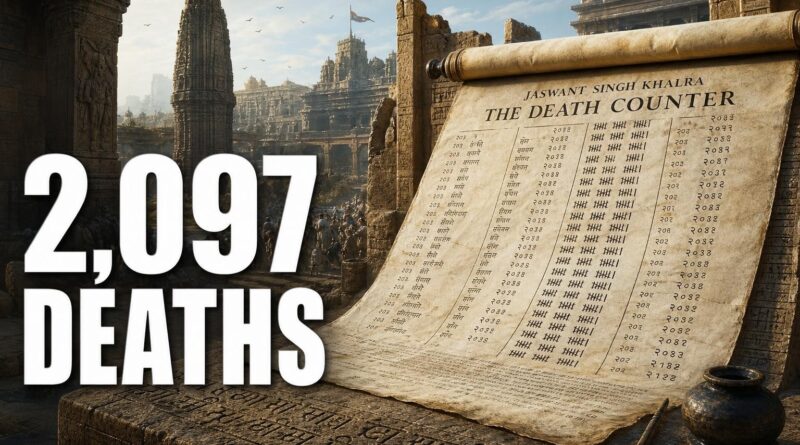
Jaswant Singh Khalra: The Death Counter
Jaswant Singh Khalra: The Death Counter
A film gets made. Then it gets cut 85 times. Then it gets renamed. Then, finally, it streams — and one of India’s most uncompromising filmmakers calls it “the most powerful Hindi film in recent times.”
That’s not a story about a movie. That’s a story about what the movie refused to stop being about.
With Satluj — starring Diljit Dosanjh — now streaming on ZEE5 and drawing attention across India, the name Jaswant Singh Khalra is back in public conversation. Most people clicking play don’t know the full story behind the man on screen. Here it is.
The Punjab Nobody Talks About
The 1990s in Punjab were not a quiet decade.
The state was caught in a brutal conflict between armed militant groups and the security forces deployed to stop them. Thousands of young men disappeared. Families filed missing person reports. Many of those reports went nowhere. Official records listed the dead as “unidentified bodies” — cremated, closed, forgotten.
That’s the version of events the state was comfortable with.
Jaswant Singh Khalra was not comfortable with it.
A human rights activist whose work centered on Tarn Taran, Khalra began doing something that sounds simple but was, in that climate, extraordinarily dangerous: he started counting. He went to cremation grounds. He cross-referenced names. He built a picture, case by case, of what had actually happened to the people who had vanished.
What he found pointed directly at the Punjab Police — and at a pattern of extrajudicial killings, secret cremations, and deliberate erasure.
What the Cremation Records Actually Said
Khalra’s investigation didn’t stay quiet for long.
He began speaking publicly about what the cremation records in Tarn Taran revealed: bodies disposed of without proper identification, without family notification, and without any legal process. He wasn’t documenting battlefield casualties. He was documenting people who had been picked up, killed, and cremated in a way designed to leave no trace — and no grieving family with standing to ask questions.
The records existed. That was the point. The state had kept paperwork on cremations it had hoped no one would ever cross-reference. Khalra cross-referenced them. What the documents showed, case by case, was a pattern too consistent to be coincidence — and too large to be explained away.
He presented his findings publicly. In a functioning system, that evidence would have triggered an investigation. Instead, it triggered something else entirely.
The Disappearance
Jaswant Singh Khalra was abducted in broad daylight — taken from outside his home. He was never seen publicly again.
His own fate mirrored the fate of the people he had been documenting: a man who exposed secret disappearances became a secret disappearance himself.
His family refused to let the case die, eventually forcing a rare moment of legal accountability — Punjab Police officers were convicted for Khalra’s abduction and murder, an outcome almost unheard of in a period defined by impunity.
But the broader reckoning — the full accounting of what happened in Punjab during those years — has never fully arrived.
A Film That Had to Fight to Exist
The original title said everything: Punjab 95. A direct reference to the decade, the state, the story. Diljit Dosanjh, one of the most recognizable Punjabi artists of his generation, was cast as Khalra. The film’s subject matter was clear, its intent unmistakable.
Then came the Central Board of Film Certification.
Before Punjab 95 could reach any audience, it reportedly underwent 85 cuts — a number that, by itself, tells you something about how uncomfortable the material made the people reviewing it. The title was changed in the process, the river Satluj replacing the year that had defined the story. According to reporting on the film’s path to release, it also faced significant legal hurdles before it could be seen at all.
When a film about a man who documented erasure gets itself partially erased before it can be seen, the irony is not subtle. The 85 CBFC cuts didn’t kill the film. They became part of its story — a second layer of evidence that some histories are still considered too dangerous to tell cleanly.
Anurag Kashyap’s July 2026 Review — And Why It Matters
Satluj eventually made it to ZEE5, where it began streaming in 2026. On July 4, 2026, filmmaker Anurag Kashyap — known for unflinching, uncomfortable storytelling — called it “the most powerful Hindi film in recent times.” That review sent searches for Jaswant Singh Khalra spiking across India.
Kashyap’s endorsement matters for a specific reason: he didn’t just recommend a movie. He reminded a national audience that this story exists — that the man who counted the dead in Tarn Taran is still worth counting.
Audiences watching Satluj now do so knowing the film was cut 85 times before it reached them. That context doesn’t sit in the background. It sits on top of every scene. The cuts didn’t erase the film. They became a confession.
Final Thought
Jaswant Singh Khalra spent his life arguing that what gets erased still happened. The cremation records were there. The names were there. The pattern was there. All it took was someone willing to look — and willing to say what they found out loud.
He paid for that with his life. The film made about him was cut 85 times and renamed before anyone could watch it. And yet here we are, in 2026, talking about him.
That’s not nothing. That’s exactly what he was trying to make possible.
Frequently Asked Questions
Who was Jaswant Singh Khalra and what did he do?
Jaswant Singh Khalra was a human rights activist from Tarn Taran, Punjab, who investigated secret cremations and extrajudicial killings by the Punjab Police in the 1990s, documenting cases of people who disappeared and were cremated without identification or family notification.
What happened in Punjab in the 1990s?
Punjab in the 1990s was caught in a brutal conflict between armed militant groups and security forces, during which thousands of young men disappeared and were allegedly killed extrajudicially, with bodies secretly cremated and officially recorded as unidentified.
What is the movie Satluj about and where can I watch it?
Satluj, starring Diljit Dosanjh, is a film based on the story of Jaswant Singh Khalra and the Punjab human rights crisis of the 1990s. It is currently streaming on ZEE5 after facing 85 cuts before release.
Recommended Reading
Explore these hand-picked resources to dive deeper into this topic:
- The Punjab Tragedy by Kuldip Nayar
- A History of Sikhs by Khushwant Singh
- 1984 (Criterion Collection Blu-ray)
As an Amazon Associate, we earn from qualifying purchases. This helps support Fact Storm Hub at no extra cost to you.
Sources
- https://scroll.in/reel/1094035/satluj-review-a-harrowing-heart-rending-tale-of-impunity-and-courage
- https://www.youtube.com/watch?v=GUVrSVlBdLw
- https://letterboxd.com/anuragkashyap/film/satluj-2026/
- https://www.thehindu.com/entertainment/satluj-movie-review-the-anatomy-of-state-violencediljit-dosanjh-panjab-95-honey-trehan/article71182649.ece
- https://www.indiaherald.com/Movies/Read/994895927/Diljit-Dosanjh-Punjab-95-Satluj-ZEE5-CBFC-Cuts-Explained
🤖 AI Content Disclosure
This article was created using AI-assisted research and writing tools, then reviewed for quality and accuracy. Facts are sourced from publicly available web research, but readers should verify critical information from primary sources.
Published for educational and entertainment purposes. Last reviewed: July 2026