
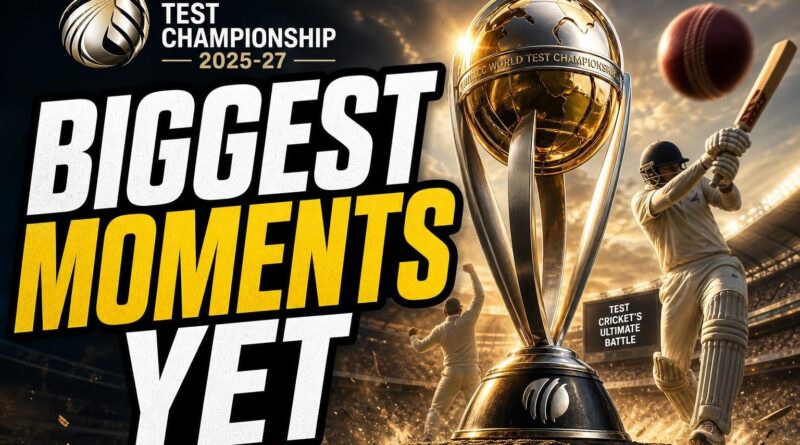
ICC World Test Championship 2025-27: Biggest Moments Yet
ICC World Test Championship 2025-27: Biggest Moments Yet
West Indies just crushed Sri Lanka by an innings and 217 runs. Not a close finish. Not a nail-biter. A complete, dominant, one-sided demolition — in a Test match that also handed Kemar Roach his 300th Test wicket. And it all counts toward something much bigger: the ICC World Test Championship 2025–2027, a three-year race that will decide who rules Test cricket by June 2027.
If you haven’t been following the WTC cycle closely, this is the moment to start. Because the standings are already shifting — and India’s path through this cycle is one of the most loaded schedules in the entire tournament.
What the ICC World Test Championship Actually Is
Most cricket fans know the WTC exists. Far fewer know how it actually works — and the rules are more interesting than the trophy.
Nine teams. 71 matches. Spread across roughly two years, from June 2025 to June 2027. The fourth edition of the ICC World Test Championship kicked off on 17 June 2025 at the Galle International Cricket Stadium, with Sri Lanka hosting Bangladesh. That first match set the tone: this cycle was going to be competitive from day one.
The points system rewards aggression. A win earns 12 points. A draw gets you 4. A tie — the rarest result in cricket — gives both teams 6 each. But because teams play different numbers of matches, the standings are decided by PCT: a percentage of points won out of points available. This matters enormously. A team that wins 4 out of 5 matches can rank higher than a team that wins 6 out of 10. Every single game carries full weight. You cannot afford to sleepwalk through a single series.
That structure is exactly why what West Indies just did to Sri Lanka is so significant.
The Innings That Changed the WTC Standings
An innings victory in Test cricket is rare. An innings victory by 217 runs is a statement.
West Indies didn’t just beat Sri Lanka in Antigua — they erased them. Winning by an innings means Sri Lanka never even got to bat a second time under normal pressure. They were bowled out, asked to follow on, and still couldn’t save the match. That’s a complete team performance: batting deep enough to build an unassailable total, then bowling the opposition out twice.
Inside that result was a milestone that speaks for itself. Kemar Roach — a fast bowler who has quietly been one of the most consistent wicket-takers in West Indian cricket history — reached 300 Test wickets during this match. It’s a landmark that only a rare group of bowlers in the entire history of Test cricket have ever reached. Roach didn’t do it with fanfare or in a high-profile bilateral series. He did it in a WTC match, in Antigua, against a Sri Lanka side that had just opened the 2025–2027 cycle at Galle.
For Sri Lanka, this result is a double blow. They hosted the very first match of this WTC cycle. Now they’ve lost a Test by an innings to West Indies. Their PCT takes a serious hit — and in a tournament decided by percentages, every loss is harder to recover from than it looks on the surface.
India’s Schedule Is the Most Watched in the Entire Cycle
Here’s where Indian fans need to pay close attention.
India’s fixtures in the 2025–2027 WTC cycle read like a greatest-hits collection of Test cricket rivalries. The Anderson–Tendulkar Trophy pits England against India — a series that carries the names of two of the greatest players the game has produced. The Freedom Trophy brings South Africa to India. There’s a series in Sri Lanka, a series in New Zealand, and then the Border–Gavaskar Trophy against Australia.
That last one carries enormous weight in a WTC context. The Border–Gavaskar Trophy between India and Australia has been the most anticipated bilateral Test series in world cricket for years — and when points from that series could be the difference between qualifying for the final and watching it from home, every session matters even more.
India knows this better than anyone. The WTC format has already produced finals that tested this team’s depth and temperament across different conditions and continents. The pressure of the PCT system means that dropping a series — even a home series — can undo months of hard work. Every dropped catch, every batting collapse, every rain-affected draw costs points that don’t come back.
The schedule isn’t just tough. It’s a gauntlet.
Why the WTC Matters More Than Any Other Cricket Tournament
Test cricket has always been considered the purest form of the game. But for years, it had a problem: there was no context. A bilateral series between two countries was just a bilateral series. Win or lose, it didn’t feed into anything larger. Fans tuned in for the spectacle, but there was no championship race to follow.
The ICC World Test Championship changed that. Since its first edition, it has given every Test match a meaning beyond the series scoreline. A draw in a WTC match isn’t just a draw — it’s 4 points instead of 12. A home loss isn’t just an embarrassment — it’s a PCT collapse that can knock a team out of final contention.
The 2025–2027 edition is the fourth cycle, and by now the format has matured. Teams plan their squads around it. Selectors think about which players are best suited for different conditions across a two-year window. Captains approach series differently when they know the points table is watching.
West Indies beating Sri Lanka by an innings and 217 runs isn’t just a great result for Caribbean cricket. It’s a WTC statement. It tells every other team in the tournament: we are here, we are competing, and we have a fast bowler with 300 Test wickets who hasn’t finished yet.
Final Thought
The ICC World Test Championship 2025–2027 is scheduled to finish in June 2027 — and the race is already producing moments that will define it. Kemar Roach’s 300th wicket in Antigua, Sri Lanka’s innings defeat, India’s loaded schedule against England, South Africa, New Zealand, and Australia — these aren’t isolated events. They are the building blocks of a two-year championship.
The next moment worth circling on your calendar: the Border–Gavaskar Trophy, India versus Australia, with WTC points on the line and two of the sport’s most competitive sides meeting in conditions that have historically decided everything. When that series arrives, the PCT table will tell you exactly how much it matters. Start watching it now.
Frequently Asked Questions
How does the ICC World Test Championship points system work?
A win earns 12 points, a draw gives 4, and a tie awards 6 to each team. Standings are decided by PCT, a percentage of points won out of points available, meaning every match carries full weight regardless of how many games each team plays.
When did the ICC World Test Championship 2025-2027 cycle start?
The fourth edition of the ICC World Test Championship kicked off on 17 June 2025 at the Galle International Cricket Stadium, with Sri Lanka hosting Bangladesh in the opening match of the new cycle.
How many teams and matches are in the ICC World Test Championship 2025-2027?
The ICC World Test Championship 2025-2027 features nine teams competing across 71 matches, spread over roughly two years from June 2025 to June 2027, with the final determining who rules Test cricket.
Recommended Reading
Explore these hand-picked resources to dive deeper into this topic:
- The Test by Jaaved Jaffer
- Eleven Gods and a Billion Indians by Sharda Ugra
- Cricket Coaching Master Class (Online Video Series)
As an Amazon Associate, we earn from qualifying purchases. This helps support Fact Storm Hub at no extra cost to you.
Sources
- https://www.cricinfo.com/series/icc-world-test-championship-2025-2027-1472510/match-schedule-fixtures-and-results
- https://en.wikipedia.org/wiki/2025%E2%80%932027_World_Test_Championship
- https://www.icc-cricket.com/tournaments/world-test-championship/matches
- https://www.espn.com/cricket/scores/series/19430/icc-world-test-championship
- https://www.youtube.com/watch?v=1kr2sPHtENI
🤖 AI Content Disclosure
This article was created using AI-assisted research and writing tools, then reviewed for quality and accuracy. Facts are sourced from publicly available web research, but readers should verify critical information from primary sources.
Published for educational and entertainment purposes. Last reviewed: July 2026