
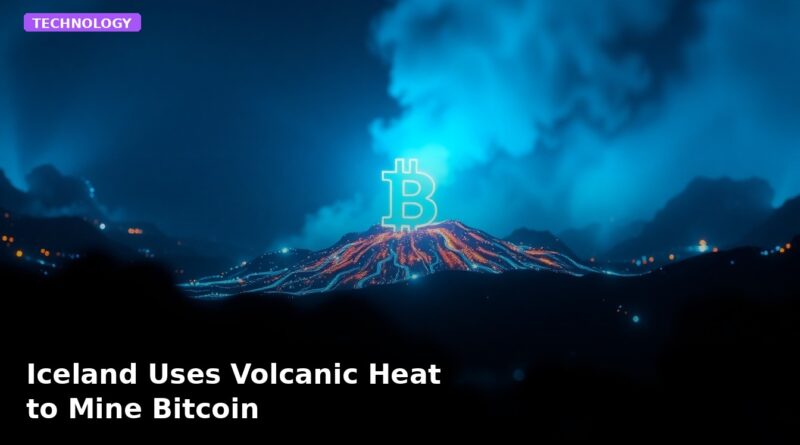
Iceland Uses Volcanic Heat to Mine Bitcoin
Iceland Uses Volcanic Heat to Mine Bitcoin
There’s a country where the ground itself generates electricity. Where magma sits close enough to the surface that engineers can tap it like a faucet. And where that raw geological power is now running some of the most energy-hungry computers on Earth — not to power homes, not to run hospitals, but to mine Bitcoin.
Iceland uses volcanic heat to do something no other country has pulled off: it became the first nation on the planet to consume more electricity mining cryptocurrency than powering all of its households combined. Let that land for a second. Every house, every apartment, every kitchen light in the country — outpaced by server racks running cryptographic equations around the clock.
So how did a small island nation in the North Atlantic become the world’s most unlikely crypto powerhouse?
The Island That Sits on a Power Plant
Iceland doesn’t generate renewable energy — it is a renewable energy source. The country runs almost entirely on renewables and has historically operated at a surplus. That’s not a policy achievement. It’s geology.
Roughly 30% of Iceland’s electricity comes from geothermal power — heat drawn directly from the volcanic activity beneath the island. The other majority comes from hydropower, fed by glacial rivers. The result is a grid that produces more clean electricity than the country can easily use.
That surplus is the key detail. Most countries fight over energy scarcity. Iceland has the opposite problem. And when you have cheap, clean electricity with nowhere to go, industries that devour power at scale start looking very attractive.
Why Bitcoin Miners Flew to a Volcano
Cryptocurrency mining is, at its core, a cooling and electricity problem. The computers running mining operations generate enormous heat and consume staggering amounts of power. In most countries, that means sky-high energy bills and an uncomfortable carbon footprint. In Iceland, it means neither.
Iceland has become a refuge for Bitcoin miners as energy costs have soared and regulatory pressure on crypto operations has mounted in the US and other regions. Cheap electricity — generated from clean sources — made Iceland the rational choice for operators who needed scale without the overhead.
The geothermal advantage compounds this further. Geothermal energy has been assessed as one of the most cost-effective and environmentally friendly options for Bitcoin mining compared to most alternative energy sources. You’re not burning coal or gas to power the rigs. You’re tapping heat that’s been sitting under the Earth’s crust for millions of years.
And Iceland’s cold climate does the rest. Arctic air handles a significant chunk of the cooling load that would otherwise require additional energy infrastructure in warmer countries.
The Stat That Stops People Cold
Here’s the number that reframes everything: Iceland became the first country where electricity used for cryptocurrency mining exceeded electricity used by all its households.
Not a close race. Not a near-miss. The first country to cross that threshold — powered in part by magma-fuelled plants that would look like science fiction anywhere else.
For tech enthusiasts, this is the real story. It’s not just that Iceland can mine Bitcoin cleanly. It’s that Iceland has scaled crypto mining to a level where it now shapes the national energy conversation. The data centre sector — which includes crypto operations and AI server farms — currently represents 5% of Iceland’s total energy use. That number is climbing.
The Next Wave: AI Moves In
Bitcoin miners weren’t the last ones to notice Iceland’s advantage. Iceland is on an upward trajectory as a destination of choice for AI server farms. The same properties that made it attractive for crypto — cheap renewable electricity, cold ambient temperatures, stable infrastructure — make it equally attractive for the data centres running large language models and AI workloads.
This is where the story gets genuinely interesting for anyone watching the AI and technology space. The global race to build AI infrastructure has a dirty secret: it consumes enormous amounts of power, and most of that power isn’t clean. Iceland offers a rare alternative — a place where you can run energy-intensive AI compute at scale without the carbon cost that comes with it almost everywhere else.
The data centre sector’s 5% share of national energy use is a signal, not a ceiling. As AI compute demand grows globally, Iceland’s volcanic grid becomes more strategically valuable, not less.
Final Thought
Iceland’s volcanic grid isn’t just a curiosity — it’s a proof of concept that the rest of the world’s energy planners are now studying closely. The fact that a country of roughly 370,000 people crossed the threshold of using more electricity on crypto mining than on its own households — and did it with near-zero carbon emissions — reframes what’s possible when geology and technology align.
The real question isn’t whether iceland uses geothermal power well. It’s whether the global AI and crypto industries can find enough Icelands to sustain their growth without torching the climate in the process. Right now, there’s only one island sitting on a magma field big enough to answer that question — and it’s already running at full speed.
Frequently Asked Questions
How does Iceland use volcanic heat to mine Bitcoin?
Iceland taps geothermal energy from volcanic activity beneath the island to generate cheap, clean electricity, which powers the massive computer systems used for Bitcoin mining operations around the clock.
Does Iceland use more electricity for crypto mining than for homes?
Yes, Iceland became the first country where electricity consumed by cryptocurrency mining surpassed the total power used by all residential households, including every house and apartment in the nation.
Why do Bitcoin miners choose Iceland for crypto mining?
Iceland attracts Bitcoin miners because of its abundant surplus of cheap, renewable electricity from geothermal and hydropower sources, solving the two core challenges of crypto mining: high energy costs and excessive heat generation.
Recommended Reading
Explore these hand-picked resources to dive deeper into this topic:
- The Bitcoin Standard by Saifedean Ammous
- Energy and Civilization by Vaclav Smil
- Renewable Energy DIY Kit (solar power educational)
As an Amazon Associate, we earn from qualifying purchases. This helps support Fact Storm Hub at no extra cost to you.
Sources
- https://www.youtube.com/watch?v=aKwZ4P6MDDc
- https://phys.org/news/2018-03-volcanic-growth-bitcoin-chilly-iceland.html
- https://www.bloomberg.com/news/videos/2023-08-31/bitcoin-mining-in-the-land-of-fire-and-ice
- https://www.abacademies.org/articles/review-of-geothermal-energy-as-an-alternate-energy-source-for-bitcoin-mining-14337.html
- https://www.wired.com/story/iceland-bitcoin-mining-gallery/
Watch the Video
🤖 AI Content Disclosure
This article was created using AI-assisted research and writing tools, then reviewed for quality and accuracy. Facts are sourced from publicly available web research, but readers should verify critical information from primary sources.
Published for educational and entertainment purposes. Last reviewed: April 2026