
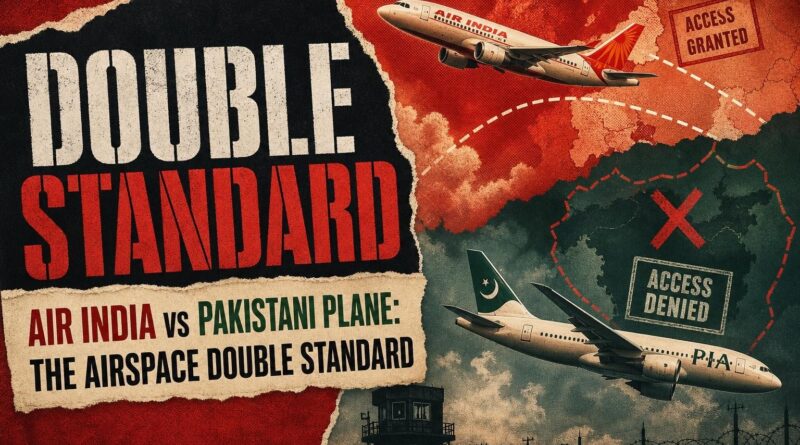
Air India vs Pakistani Plane: The Airspace Double Standard
Air India vs Pakistani Plane: The Airspace Double Standard
This week, Air India made headlines across India — and not for the reasons an airline ever wants to.
On June 22, 2026, Air India flight AI479, an Airbus A321 operating the Delhi-to-Amritsar route, briefly crossed into Pakistani airspace during a go-around manoeuvre over Amritsar airport. The DGCA grounded the crew almost immediately. The story spread fast: Indian airline, Indian crew, Pakistani airspace — a diplomatic flashpoint wrapped inside an aviation incident.
But here’s what the headlines buried.
Ten days earlier, three Pakistani commercial aircraft had entered Indian airspace — and one of them stayed inside for more than 15 minutes.
The Incident Everyone Heard About
Amritsar sits close to the India-Pakistan border. Dangerously close, from an aviation standpoint. The airport’s approach paths leave almost no margin for error when weather, mechanical issues, or a sudden bird strike forces a pilot to abort a landing and circle back around.
That’s exactly what happened to flight AI479 on June 22, 2026. The crew was conducting a go-around — a standard, trained procedure where a pilot aborts a landing that doesn’t feel safe and climbs back up to attempt another approach. During a bird strike inspection, the aircraft briefly crossed into Pakistani airspace.
The total time inside Pakistani airspace: under two minutes.
Pakistan has kept its airspace closed to Indian airlines since April 2025, which means even a momentary crossing carries serious diplomatic weight. The DGCA acted swiftly, grounding the Air India crew pending investigation. The incident became national news within hours.
What didn’t become national news, at least not with the same urgency, happened ten days before — on the other side of the border.
The Story That Ran Quietly Underneath
June 12, 2026. Severe weather battered the airspace around Lahore, forcing Pakistani commercial flights to divert or reroute on short notice.
Flight-tracking data from Flightradar24 — the same platform aviation enthusiasts and journalists use to monitor real-time aircraft positions — showed that at least three Pakistani commercial aircraft entered Indian airspace that day. Two were Fly Jinnah flights: one on the Lahore-Dubai route, the other on the Lahore-Jeddah route. The third was an Air Sial flight travelling from Dammam back to Lahore.
All three entered Indian airspace during the weather disruption.
One of them stayed for more than 15 minutes.
To put that in perspective: the Air India crew that got grounded was inside Pakistani airspace for under two minutes. The Pakistani aircraft that attracted almost no comparable attention was inside Indian airspace for over fifteen. That’s not a rounding error — that’s a seven-fold difference in duration.
Why This Asymmetry Matters
Airspace rules are not simply about national pride. They exist because sovereign airspace is treated in international law the same way territorial waters are — crossing it without permission is a violation, regardless of how long the crossing lasts or what caused it.
When Pakistan closed its airspace to Indian airlines in April 2025, it created an unusual situation: two neighbouring countries sharing some of the busiest aviation corridors in Asia, now operating under a strict no-entry policy in one direction. Indian carriers reroute flights, burn more fuel, and add hours to journey times as a result.
What the June 12 Flightradar24 data reveals is that airspace, in practice, is messier than the rules suggest. Weather doesn’t respect closed borders. A storm over Lahore doesn’t pause to check which country’s airspace offers the safest diversion. Pilots facing severe weather make real-time decisions — and sometimes those decisions cross a line on a map.
That’s not a justification. It’s context. And context is exactly what gets lost when one incident gets grounded crews and front-page coverage, while another gets a footnote.
What the Flightradar24 Data Actually Tells Us
Flightradar24 is not a government source. It aggregates ADS-B signals — the automatic transponder data that modern commercial aircraft broadcast continuously. It is the same data used by aviation journalists, air traffic researchers, and curious passengers tracking their relatives’ flights. When Flightradar24 shows a Pakistani aircraft inside Indian airspace, that is not speculation. That is a transponder signal, timestamped and logged.
The fact that this data existed, was publicly accessible, and still took days to surface in mainstream coverage says something about how airspace stories get told. The Air India incident had a named flight number, a grounded crew, and an official DGCA response — all the ingredients of a news cycle. The June 12 diversions had radar data and a weather event. One story had spokespeople. The other had coordinates.
Both involved commercial aircraft crossing a closed border. Only one became a national conversation.
Final Thought
The Air India AI479 incident on June 22, 2026 was real, the DGCA’s response was swift, and the crew’s accountability is legitimate. But the Flightradar24 data from June 12 — showing a Pakistani aircraft inside Indian airspace for more than 15 minutes — doesn’t cancel that story. It complicates it.
What this week actually revealed is that when Pakistan closed its airspace to Indian airlines in April 2025, it created a one-sided pressure point that weather, geography, and the physics of aviation were always going to test. Amritsar is close to the border. Lahore is close to the border. Storms don’t read NOTAMs.
The question worth asking now isn’t which crew behaved worse. It’s whether the closed-airspace arrangement between two countries sharing some of Asia’s busiest flight paths is sustainable — or whether June 2026 just showed us the first cracks.
Frequently Asked Questions
Why did Air India flight AI479 enter Pakistani airspace?
Air India flight AI479 entered Pakistani airspace briefly during a go-around manoeuvre over Amritsar airport after a bird strike inspection. The crew aborted the landing for safety reasons, crossing into Pakistani airspace for under two minutes.
What happened to the Air India crew after entering Pakistani airspace?
The DGCA grounded the Air India crew almost immediately after the incident on June 22, 2026, pending investigation. The crossing carried serious diplomatic weight because Pakistan has kept its airspace closed to Indian airlines since April 2025.
Did Pakistani planes enter Indian airspace too?
Yes, ten days before the Air India incident, three Pakistani commercial aircraft entered Indian airspace on June 12, 2026, with one remaining inside for more than 15 minutes, reportedly due to severe weather around Lahore.
Recommended Reading
Explore these hand-picked resources to dive deeper into this topic:
- The India Story by Bimal Jalan
- 1971: A Global History of the Creation of Bangladesh by Srinath Raghavan
- National Geographic Atlas of the World (comprehensive reference)
As an Amazon Associate, we earn from qualifying purchases. This helps support Fact Storm Hub at no extra cost to you.
Sources
- https://www.ndtv.com/india-news/3-pakistani-flights-entered-indian-airspace-days-before-air-india-incident-11683024
- https://www.youtube.com/watch?v=Bp0Zzt_W29Q
- https://www.firstpost.com/india/3-pakistani-flights-entered-indian-airspace-during-storm-emergency-days-before-air-india-crossed-into-pak-14025926.html
- https://www.thehindu.com/news/national/air-india-plane-strays-into-pakistan-airspace-dgca-takes-action-against-air-traffic-controller-crew/article71143252.ece
- https://www.youtube.com/watch?v=H-wjWpZW07A

🤖 AI Content Disclosure
This article was created using AI-assisted research and writing tools, then reviewed for quality and accuracy. Facts are sourced from publicly available web research, but readers should verify critical information from primary sources.
Published for educational and entertainment purposes. Last reviewed: June 2026